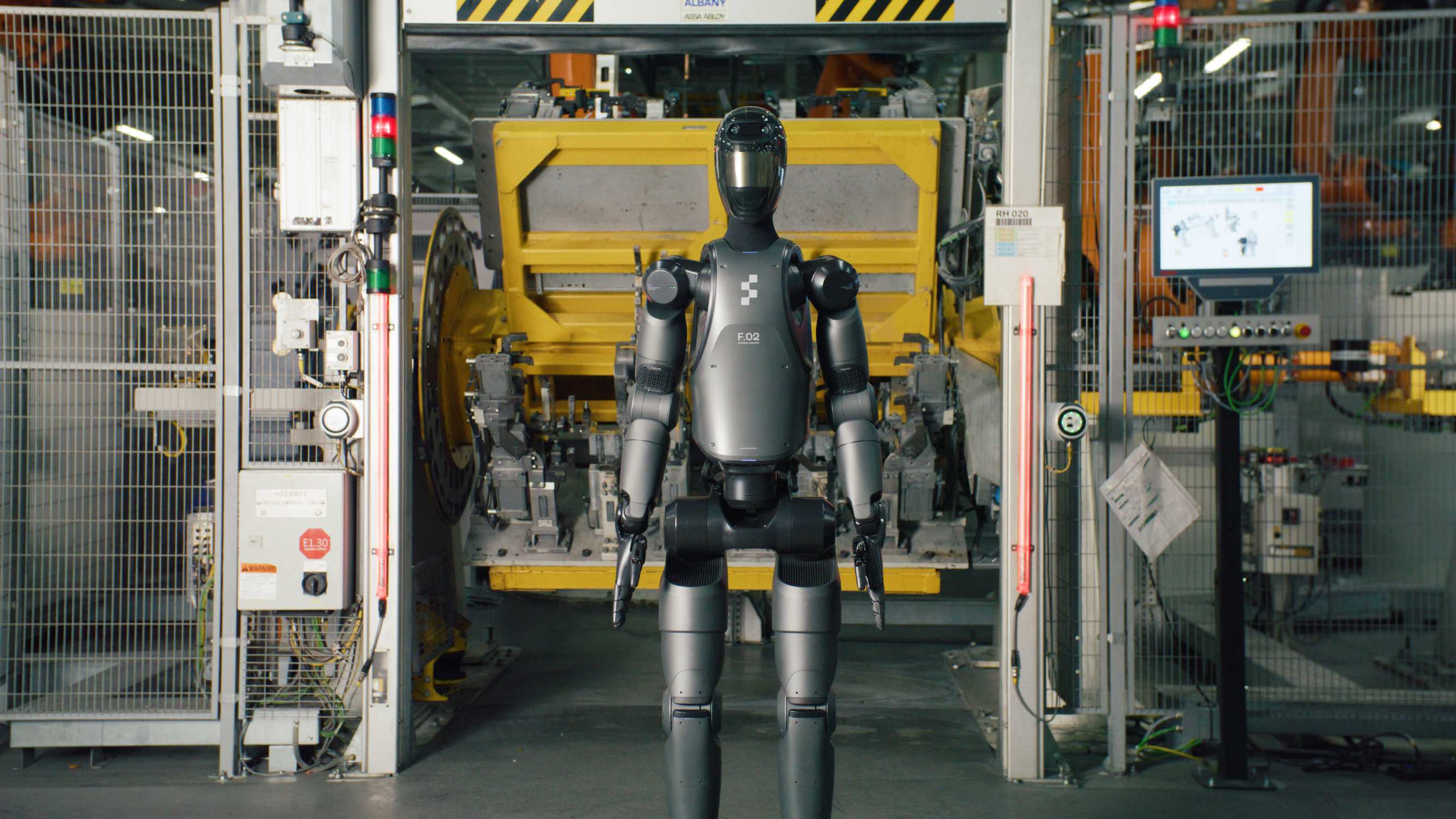
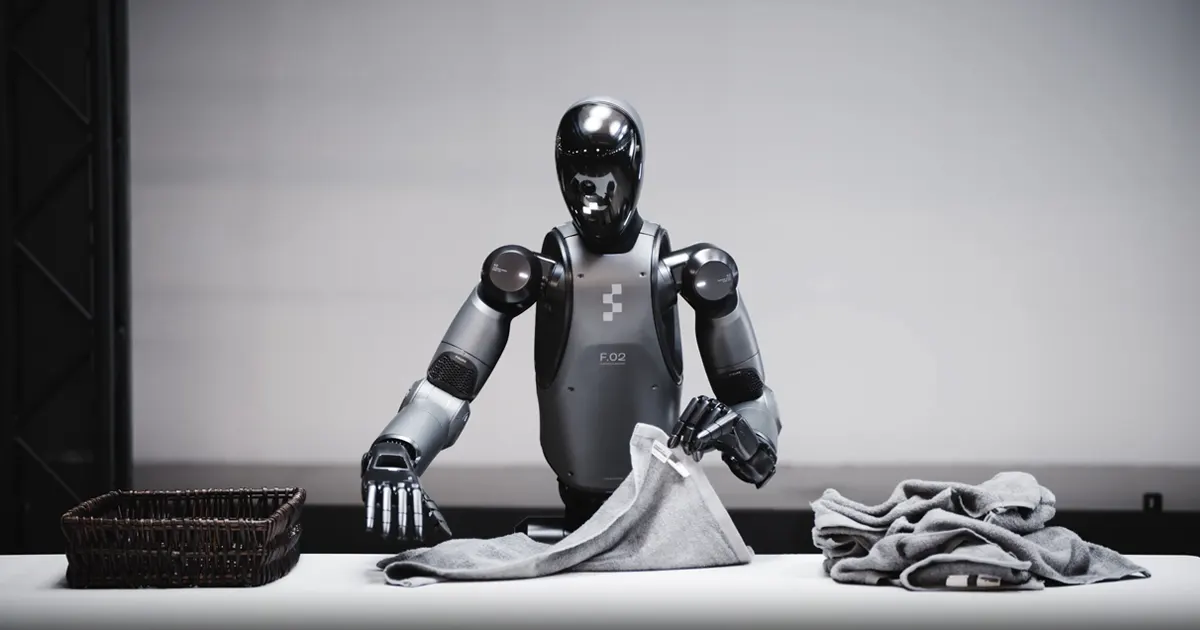
Explore by Humanoid Brand

TSL · Tesla, Inc. · Austin, TX

TESLA
OPTIMUS

Tesla's general-purpose bipedal humanoid robot — built on the same AI and autonomy stack as Full Self-Driving. Designed for unsafe, repetitive, or boring tasks across factories, logistics, and eventually consumer homes.
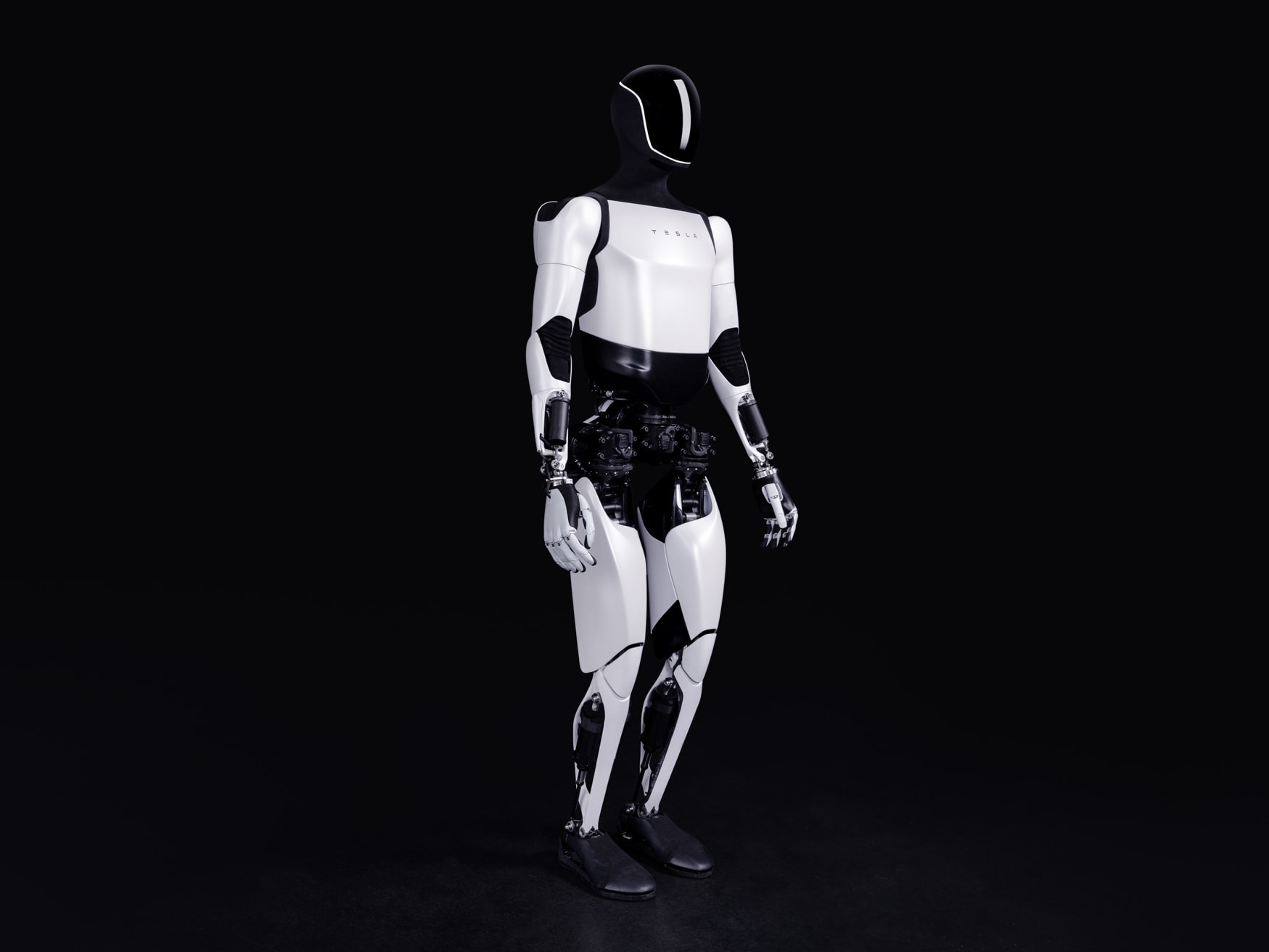
Humanoid / AI Bipedal FSD-Derived AI Not Yet Consumer Available Gen 2 Body · Gen 3 Hands
Tesla Optimus official image In Production
Courtesy of Tesla, Inc. · Official media asset · androids.com editorial use
01Technical Specifications
Height
173 cm
5 ft 8 in · Gen 2 body
Weight
57 kg
125.6 lbs
Payload (carry)
20 kg
44 lbs confirmed
Walking Speed
~8 km/h
Gen 2; ~10–12 projected Gen 3
Battery
2.3 kWh
~8 hrs operational
Power Draw
100W idle · 500W walking
Peak during manipulation higher
Body DOF
40+
28 body actuators (7 types)
Hand DOF (Gen 3)
22
Per hand · 50 total actuators
Hand DOF (Gen 2)
11
Doubled in Gen 3
Compute (Gen 2)
Tesla AI4 FSD
Same platform as vehicles
Compute (Gen 3)
Tesla AI5
~40× AI4 performance
Cameras
8
576 MP/s · 360° · No LiDAR
Target Retail Price
$20,000 – $30,000
At scale · Est. current cost $50K–$100K · Not for sale Q1 2026
Voice AI (Gen 3)
Grok (xAI)
Natural language task instruction
02Generation Comparison
GEN 1
PROTOTYPE · OCT 2022
Walking Speed<2 km/h
Hand DOFBasic grasping
ComputeEarly FSD chip
AutonomyTeleoperated
StatusProof of concept
GEN 2
REVEAL · DEC 2023
Walking Speed8 km/h
Hand DOF11 per hand
ComputeTesla AI4 FSD
AutonomySemi-autonomous
StatusFactory testing
GEN 3 HANDS
PRODUCTION · JAN 2026
Walking Speed~10–12 km/h projected
Hand DOF22/hand · 50 actuators
ComputeTesla AI5 (~40× AI4)
AutonomyAutonomous factory tasks
StatusMass production Fremont

"Gen 3" refers to upgraded hands only — body remains Gen 2 design (173 cm, 57 kg). * Deadlift target not officially confirmed.

03AI Architecture & Autonomy

FSD-Derived Intelligence

Optimus runs on an adaptation of Tesla's Full Self-Driving computer — trained on billions of vehicle miles. Eight cameras generating 576 megapixels per second feed end-to-end neural networks. No LiDAR, no radar. Gen 3 adds Grok for natural language task instruction and learning by video observation.

8B+
FSD Miles Logged
Shared AI training base with Optimus
8
Cameras · 576 MP/s
360° vision · No LiDAR
40×
AI5 vs AI4 Performance
Gen 3 chip for real-time VLA inference
Grok
Voice AI — Gen 3
Natural language task instruction

Fleet Learning

Every factory interaction trains the same central model. Task generalization improves at fleet scale — the same dynamic that accelerated FSD after broad deployment.

Dojo Supercomputer

Training runs on Tesla's Dojo cluster. The same infrastructure that trains FSD on road footage processes robot manipulation sequences.

Joint Torque Sensing

Every actuator includes real-time torque sensing. Foot sensors enable dynamic balance and slip detection. Gen 3 adds per-finger tactile feedback.

Learn by Observation

Gen 3 acquires skills by watching human demonstrations via video. Voice instructions via Grok allow task specification in plain English.

04Gen 3 Hand System

The Forearm Architecture

From 11 DOF to 22 DOF per hand — with all 25 actuators per side relocated into the forearm via a tendon-driven system, replicating human forearm muscle anatomy. Revealed February 17, 2026: "This bot got hands."

Total Actuators
50
25 per forearm/hand
Degrees of Freedom
22
Per hand · 2× Gen 2
Actuation Type
Tendon-driven
Actuators in forearm
Precision Screws
C3 Ball Screws
3 micron lead error/300mm
Tactile Feedback
Per-finger
Real-time grip pressure
Task Multiplier
More discrete tasks vs Gen 2
05Applications & Use Cases

Where Optimus Works

Manufacturing

Parts kitting, 4680 battery cell sorting, quality inspection. Currently deployed at Fremont and Giga Texas.

Logistics

Warehouse picking, order fulfillment, goods transport. External commercial customers expected H2 2026.

Healthcare

Patient assistance, supply delivery. Long-term application; requires safety certification not yet in place.

Consumer / Home

House chores, errands, elderly care. Consumer units targeted 2028+ per Tesla's We, Robot framing.

DEPLOYMENT STATUS Q1 2026 — Optimus is not available for consumer or commercial purchase. Units are deployed internally for training data collection. External sales targeted H2 2026, consumer sales no earlier than late 2027.

06Production Roadmap
2022
Complete
Gen 1 prototype. First steps on stage.
2023
Complete
Gen 2 revealed. 11-DOF hands. Factory beta testing.
2024
Complete
Autonomous factory deployment. Two units at Giga Texas daily.
2025
In Progress
~5,000 unit target. Pilot line. Gen 3 hands mass production Jan 2026.
2026
Active
Model S/X lines converted. 50,000 unit target. First enterprise sales H2. $20B CapEx.
2027
Planned
Consumer sales begin. Fleet learning accelerates. "Starts changing lives."
2028+
Target
Consumer units at $20–30K. Home task capability expands.
Long-term
Vision
1M units/year. Giga Texas 10M+ potential. Musk's most impactful product.
07Latest Developments
MAR 2026
Gen 4 Mentioned at Abundance Summit
Musk briefly mentioned Optimus Gen 4 with no specs or timeline. 1M units/year long-term capacity reiterated.
Roadmap
FEB 2026
"This Bot Got Hands" — Gen 3 System Revealed
50-actuator, 22-DOF Gen 3 hands unveiled Feb 17. Forearm tendon architecture. Learns by observing humans.
Hardware
JAN 2026
Mass Production Commences at Fremont
Gen 3 hands in mass production Jan 21. Model S/X lines converted. $20B CapEx. Consumer sales targeted end of 2027.
Production
NOV 2025
Shareholder Meeting — Musk and Optimus Dance
Kung fu demo confirmed autonomous. Model S/X lines committed to Optimus. Neuralink integration hinted.
Demo
MAR 2025
5,000 Units Target for 2025 Confirmed
All-hands: ~5,000 units for 2025, parts for 10,000–12,000 ordered. 50,000 target for 2026 reiterated.
Production

Full development history → Tesla Optimus Development Timeline →

08Primary Sources

Tesla, Optimus, Tesla Bot are trademarks of Tesla, Inc. Androids.com is independent. Image credit: Courtesy of Tesla, Inc. Specs compiled from public filings, earnings calls, and verified press reports. Updated March 2026.

Courtesy of Tesla, Inc. · Data sourced from manufacturer specs, Tesla earnings calls, and verified press reporting · Updated March 2026
TSL · Development Timeline · Part 1 of 3

OPTIMUS
2021 – 2022

The origin story — from Elon Musk's first public announcement at AI Day 2021, through the unveiling of the first physical Gen 1 prototype at AI Day 2022. The year Tesla proved the concept was real hardware.

2
Years covered
2
AI Day events
1
Physical prototype
<2
km/h walking speed

Part 1 Context — 2021 to 2022

When Musk announced Tesla Bot at AI Day 2021, the robot didn't exist — a human in a costume danced on stage as a placeholder. Twelve months later, physical hardware walked across a stage under its own power. This part covers those two foundational years: the concept announcement, the engineering sprint, and the first public proof that Tesla's humanoid program was real hardware, not vaporware.

2021
The Announcement
Tesla announces its humanoid robotics program at AI Day. No hardware exists — the robot is introduced via a human in a costume. Musk establishes the core concept, dimensions, and use case framing that defines the program to this day.
AUG 192021
Founding Moment
Tesla AI Day — "Tesla Bot" Announced to the World
At Tesla's inaugural AI Day on August 19, 2021, Elon Musk announced the Tesla Bot. A performer in a robot costume danced on stage as a stand-in — no hardware existed yet. Musk laid out the core concept: a robot designed for tasks that are "dangerous, repetitive, or boring."

Key dimensions: 5'8" tall (173 cm), 125 lbs (57 kg), max speed 5 mph. Specifically framed as unable to outrun a human — an intentional safety signal. The robot would use Autopilot cameras for vision and the FSD computer for inference. Musk said a prototype was expected "probably" in 2022.
Program officially launched Height: 5'8" (173 cm) Weight: 125 lbs (57 kg) Max Speed: 5 mph Compute: Tesla FSD chip
Tesla Optimus official image

Courtesy of Tesla, Inc.

2022
First Hardware — Gen 1 Prototype
Tesla builds the first physical prototype in roughly 12 months — an extraordinary engineering sprint. AI Day 2 delivers the moment: actual bipedal hardware walks on stage under its own power for the first time.
SEP 302022
Hardware Milestone
AI Day 2 — Two Prototypes Unveiled. Gen 1 Walks on Stage.
At Tesla AI Day 2 on September 30, 2022, Tesla unveiled two physical robots: "Bumble C" — a functional working prototype in partial assembly — and "Optimus" — a more finished prototype. Bumble C walked slowly across the stage under its own power. This was the first public demonstration of Tesla's bipedal locomotion in actual hardware.

The hardware used Tesla's FSD computer for inference and entirely custom-designed actuators — not off-the-shelf components. Walking speed was under 2 km/h, but the fact that any hardware existed less than 13 months after announcement established the seriousness of the program. The event triggered broad investor and competitor interest in humanoid robotics as a near-term commercial category.
First public bipedal walk Walking Speed: <2 km/h Actuators: Custom Tesla design Compute: Tesla FSD chip 13 months from announcement to hardware

What 2022 Established

By the end of 2022, Tesla had proven two things: it could build bipedal hardware fast, and it could leverage its existing AI and manufacturing infrastructure for robotics. The FSD computer, Autopilot vision stack, and in-house actuator manufacturing all transferred directly. The competitive moat — that no other car company had accidentally built a robotics AI company — was now physically demonstrated. Gen 1 was slow and limited, but it existed. The race was on.

Tesla, Optimus, and Tesla Bot are trademarks of Tesla, Inc. Androids.com is independent. Image: Courtesy of Tesla, Inc. Updated March 2026.
TSL · Development Timeline · Part 2 of 3

OPTIMUS
2023 – 2024

The iteration years — from slow prototype to autonomous factory worker. Gen 2 debuts with 11-DOF hands, walking speed doubles, and by end of 2024 two units operate independently inside Tesla factories every single day.

2
Years covered
11
Hand DOF Gen 2
22
Hand DOF Announced
8
km/h Gen 2 speed
2
Autonomous units

Part 2 Context — 2023 to 2024

2023 and 2024 are the years that transformed Optimus from a slow-walking concept into a robot capable of autonomous factory work. Walking speed improved 4×, hand dexterity doubled twice, and by the end of 2024 two Optimus units were operating independently at Giga Texas daily. Gen 2 — revealed December 2023 — set the body design that still ships in 2026.
2023
Rapid Iteration · Gen 2 Revealed
2023 is the year Optimus transitions from walking prototype to capable manipulator. Each public demo shows measurable improvement. Gen 2 is revealed in December — a complete hardware refresh with polished aesthetics and 11-DOF hands.
JAN2023
Hardware
First Unsupported Walking Demonstrated Publicly
Tesla released video of Optimus walking without support structures for the first time. Movement is slow and deliberate, but unassisted bipedal locomotion in actual hardware was confirmed. Meaningful progress from the AI Day 2 prototype four months earlier.
First unsupported walk
MAR2023
Strategy
Musk: Mass Production Target 2027, "Affordable for Everyone"
Musk announced Tesla aimed to begin mass production of Optimus by 2027, with the goal of making it affordable for everyone. This was the first public mass-production timeline and the first framing of Optimus as a consumer product.
MAY2023
Demo
Annual Shareholder Meeting — Improved Dexterity Demo
At Tesla's 2023 shareholder meeting, an updated Optimus demonstrated improved dexterity and object manipulation, including picking up and moving objects. Signalled that hand capability was advancing in parallel with locomotion.
SEP2023
Production Intent
Factory Deployment Plans Revealed — Internal Manufacturing Use Confirmed
Musk revealed Tesla plans to deploy Optimus in its own factories for material handling and assembly tasks. First public statement of an actual operational deployment plan — the "own factories first" strategy gave Tesla a closed-loop environment for training data collection.
NOV2023
Production
Factory Beta Testing Begins in Tesla Facilities
Tesla began beta testing Optimus robots in several Tesla factories. Primary goal: data collection and real-world capability refinement, not productive output. First time Optimus operated in an actual production environment.
First factory deploymentGoal: data collection
DEC 122023
Hardware Milestone
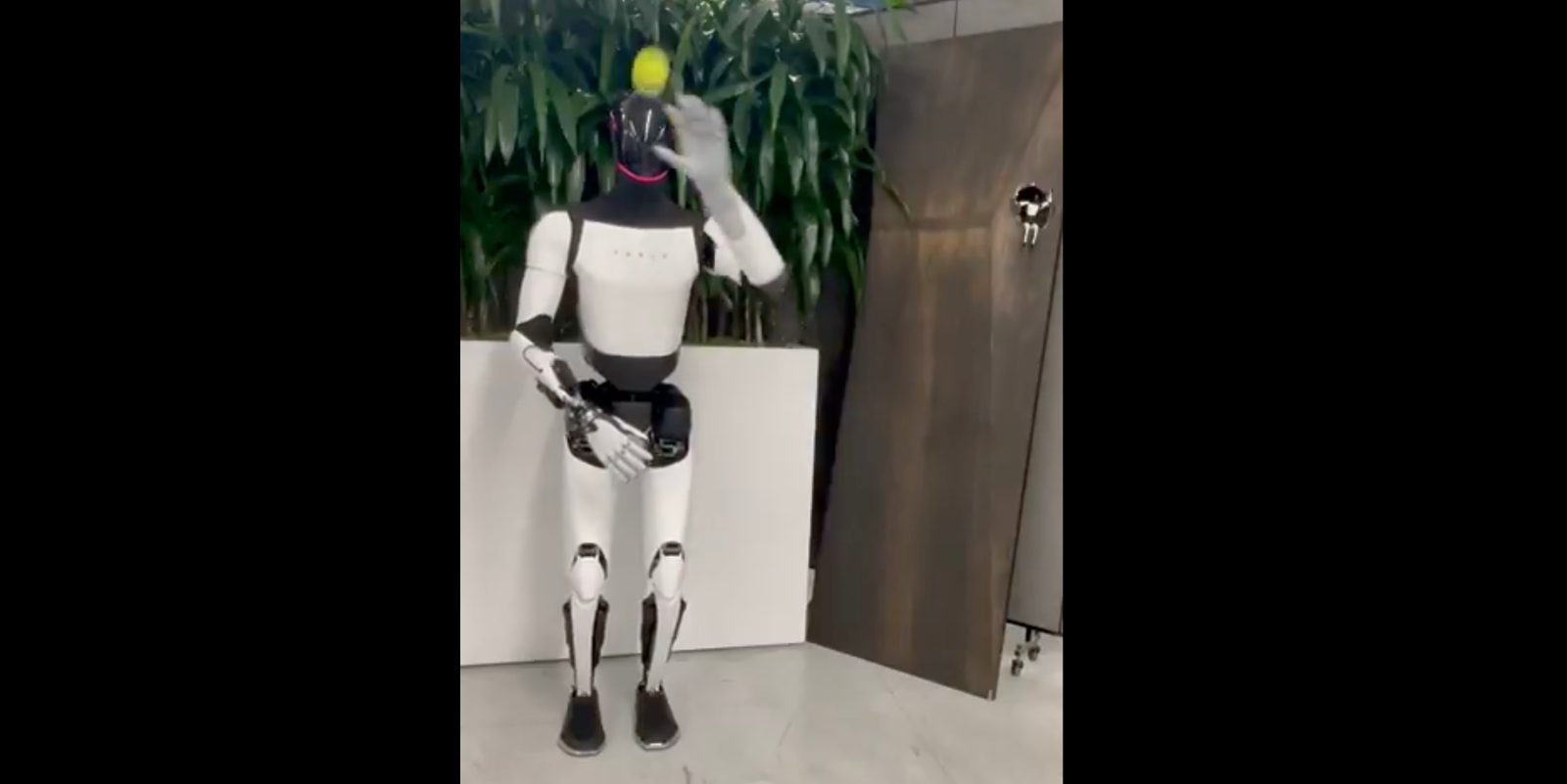
Gen 2 Unveiled — 11-DOF Hands, Polished Design, Egg Test Passed
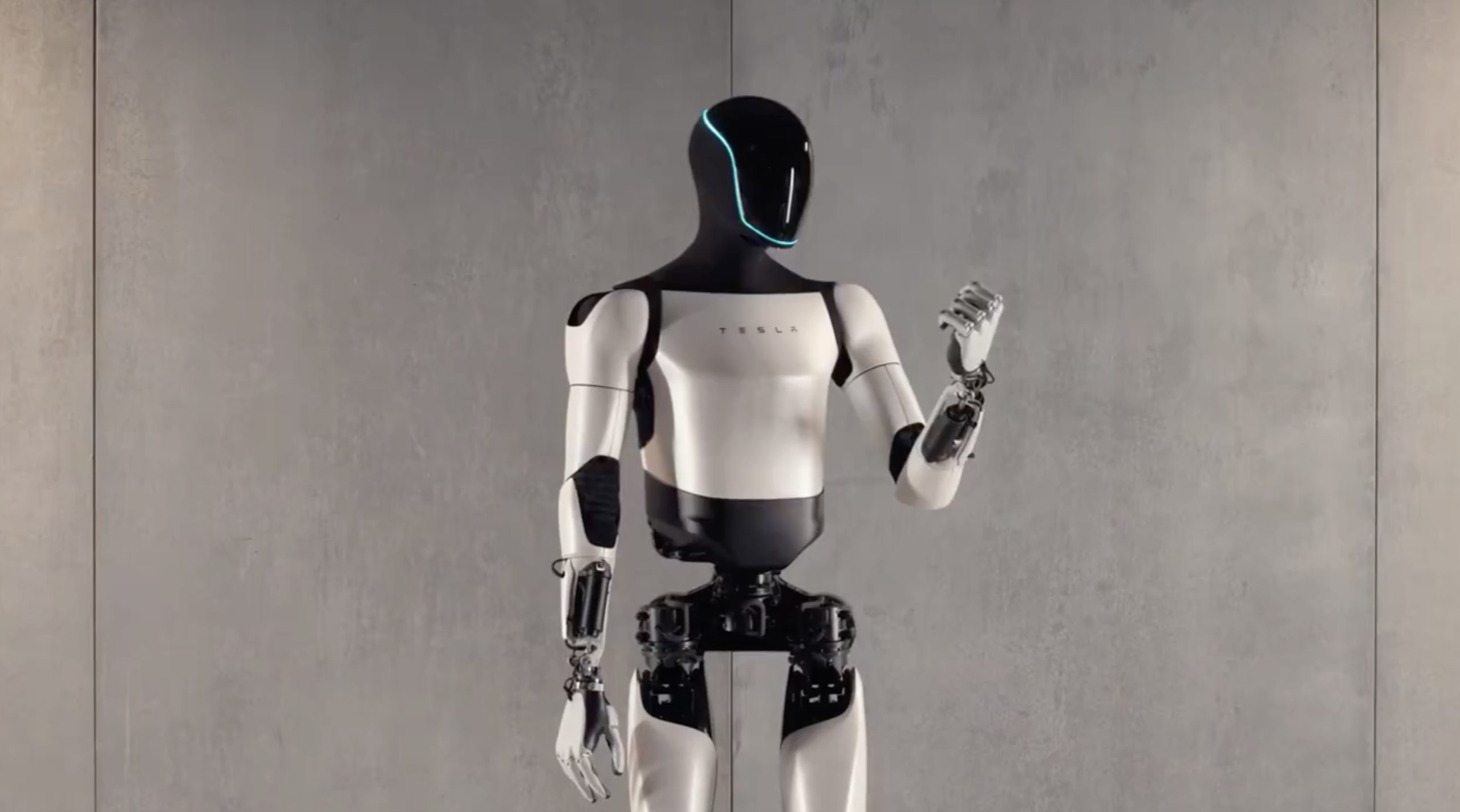
On December 12, 2023, Tesla unveiled Optimus Gen 2. Key upgrades: 11 degrees of freedom per hand with 3D-printed finger covers, tactile sensors sensitive enough to pick up a raw egg without breaking it (the defining demo clip), white polished cover panels, mesh at neck and shoulders, significantly improved walking speed and natural biomechanical sway. The Gen 2 body design — 173 cm, 57 kg — is the same design still in production in 2026.
Gen 2 body design · still ships 2026 Hand DOF: 11 per hand Passed raw egg test 173 cm · 57 kg Walking: ~5 km/h
Tesla Optimus Gen 2
2024
Autonomy · Factory Deployment
2024 marks the shift from demonstration to genuine autonomous operation. Two units work independently in Tesla factories. Hand DOF doubles. Walking speed and stability reach human-like quality. First productive manufacturing task demonstrated.
FEB2024
Hardware
Walking Speed +30% — Vestibular System and Gait Overhaul
Milan Kovac (Head of Optimus Engineering) documented walking speed reaching ~0.6 m/s — a 30% increase from December 2023. Improvements spanned vestibular system, foot trajectory, ground contact logic, and loop latency. The robot began exhibiting natural torso and arm sway — the biomechanical marker of stable, human-like gait.
Speed: 0.6 m/s+30% vs Dec 2023Natural torso/arm sway
APR2024
Deployment
Two Optimus Units Deployed Autonomously at Giga Texas — Daily
Tesla confirmed that two Optimus robots were performing factory tasks autonomously — without human teleoperation — at Giga Texas, on a daily basis. First confirmed instance of autonomous Optimus operation in a real production environment.
First autonomous factory deploymentLocation: Giga TexasMode: No teleoperation
MAY2024
Hardware
Hand DOF Doubles — 11 to 22 Announced. First Productive Manufacturing Task.
Tesla announced hand upgrade: DOF increasing from 11 to 22 per hand — approaching the 27 DOF of a human hand. Simultaneously demonstrated Optimus loading 4680 battery cells in factory settings — the first genuinely productive manufacturing task demonstrated in a real production context.
Hand DOF: 11 → 22 announcedFirst productive factory taskTask: 4680 battery cell loading
JUN2024
Hardware
Walking Speed +30% Again — Full Biomechanical Gait Achieved
Walking speed improved a further 30% with full human-like biomechanics: smooth heel-to-toe contact, torso rotation, and coordinated arm swing. Total speed improvement from Gen 1's <2 km/h was now approaching 8 km/h — a 4× increase in two years.
~8 km/h total Gen 2 speed4× improvement over Gen 1
JUL2024
Business
Musk Sets Public Timeline: Internal 2025, External Sales 2026
Musk confirmed: low-scale production for internal use in 2025, external company sales by 2026. First time both year targets appeared in a single public statement — the clearest commitment to date on the deployment roadmap.
2025: Internal low-scale2026: External sales
NOV2024
Hardware
Upgraded Hand Demo — More Dexterity, Still Teleoperated
Tesla unveiled an upgraded hand demonstrating improved dexterity. The demo was teleoperated — a recurring note in press coverage. The hand design visibly pointed toward the Gen 3 forearm-actuated architecture that would enter mass production in January 2026.
Tesla Optimus upgraded hand Nov 2024
DEC2024
Demo
Autonomous Uneven Terrain Navigation — Neural Net Limb Control
Tesla released video of Optimus traversing uneven terrain autonomously — using neural networks for limb control to recover from slips without vision override or remote input. Units confirmed navigating offices and labs daily. This added a new dimension to the autonomy story: real-world physical unpredictability, not just flat floor navigation.
Autonomous terrain recoveryNo vision overrideDaily autonomous office navigation

What 2023–2024 Established

By end of 2024, Optimus had transformed from a demo robot into an operational one. Two units worked autonomously in a real factory every day. The Gen 2 body — unchanged since December 2023 — was mature and stable. Walking improved 4×. Hands were heading toward 22 DOF. The first productive manufacturing task was on video. The question was no longer whether Optimus could work — it was how fast Tesla could make them.

Tesla, Optimus, Tesla Bot are trademarks of Tesla, Inc. Androids.com is independent. Updated March 2026.
TSL · Development Timeline · Part 3 of 3

OPTIMUS
2025 – 2026

The production era — from pilot line to Fremont mass manufacturing. Thousands of units targeted, Model S/X lines converted, Gen 3 hands revealed, and a firm consumer sales date of end-2027 publicly committed.

50
Gen 3 actuators
22
Hand DOF
50K
2026 unit target
$20B
2026 CapEx
2027
Consumer sales

Part 3 Context — 2025 to 2026

This is the period where Optimus graduates from research project to manufactured product. The pilot production line goes live. Tesla commits $20 billion in CapEx. The Fremont Model S and X lines are converted. Gen 3 hands enter mass production. And Musk sets a public consumer sales date: end of 2027. The big caveat: Musk admitted on the Q4 2025 earnings call that current units are "primarily for learning, not productive tasks" — still in the R&D phase.

2025
Pilot Production · Scale Planning
Tesla targets thousands of internal Optimus units in 2025. Pilot production line established at Fremont. Gen 3 hand architecture engineered. The year culminates with the shareholder meeting that committed Fremont's Model S/X lines to Optimus — the most concrete production commitment in the program's history.
JAN2025
Earnings
Q4 2024 Earnings — Pilot Production Confirmed for 2025
Q4 2024 earnings confirmed latest generation hand, robust locomotion improvements, and training on additional tasks. Pilot production formally confirmed for 2025. Targets stated: several thousand units in 2025, scaling to 50,000–100,000 in 2026. First earnings call where Optimus received significant dedicated investor coverage.
Pilot production confirmed 20252025 target: several thousand2026 target: 50,000–100,000
MAR2025
Production Planning
All-Hands: 5,000 Units for 2025, Parts for 10,000–12,000 Already Ordered
At a Tesla all-hands meeting, Musk confirmed ~5,000 Optimus robots targeted for 2025. More significantly: parts for potentially 10,000–12,000 units had already been ordered — supply chain commitment already underway. At this volume, Tesla would produce more humanoid robots than the rest of the industry combined.
2025 target: ~5,000 unitsParts ordered: 10,000–12,0002026 target: 50,000
SEP2025
Production Update
"Working Hard" — Active Scale Progress at Fremont Pilot Line
Musk confirmed Tesla is actively scaling Optimus production. Pilot production line running at Fremont. Real-world factory testing ongoing — primarily for training data collection to build the dataset needed for autonomous task execution at scale.
OCT2025
Demo
Kung Fu Demo — Confirmed Fully Autonomous by Musk
Tesla released footage of Optimus performing kung fu-style reactive movement. Musk confirmed on X this was fully autonomous — not teleoperated. The robot's real-time response to dynamic physical inputs demonstrated proprioceptive control not previously confirmed publicly. Served as a counter-narrative to "is it really autonomous?" coverage.
Confirmed autonomous by MuskReactive dynamic movement
NOV2025
Annual Meeting
Musk and Optimus Dance at Shareholder Meeting · Model S/X Production Ends
Elon Musk and an Optimus robot danced on stage as shareholders approved Musk's $1 trillion CEO pay package — one of the most-shared moments in Optimus's public history.

The substantive announcement: Tesla would end Model S and X production at Fremont to convert those lines for Optimus manufacturing — Tesla literally trading its two most iconic legacy vehicles for robot manufacturing capacity. Musk also hinted at crime deterrence and Neuralink consciousness upload integration use cases.
Model S/X lines → Optimus linesModel S/X end of productionNeuralink integration hinted
2026
Mass Production Begins
2026 opens with the most consequential Optimus announcements to date: mass production commences, Gen 3 hands fully revealed, $20B CapEx committed, and a firm consumer sales date of end-2027. The tension: Musk simultaneously admits robots aren't yet doing useful work.
JAN 212026
Production Milestone
Mass Production of Gen 3 Hands Commences at Fremont
Tesla officially commenced mass production of Optimus Gen 3 hands at Fremont on January 21, 2026. Key clarification: "Gen 3" refers specifically to the upgraded 22-DOF, 50-actuator hands — the robot body remains the Gen 2 design (173 cm, 57 kg) unchanged since December 2023.

Fremont Model S and X production lines were being repurposed for Optimus manufacturing — Musk called it giving those vehicles an "honorable discharge."
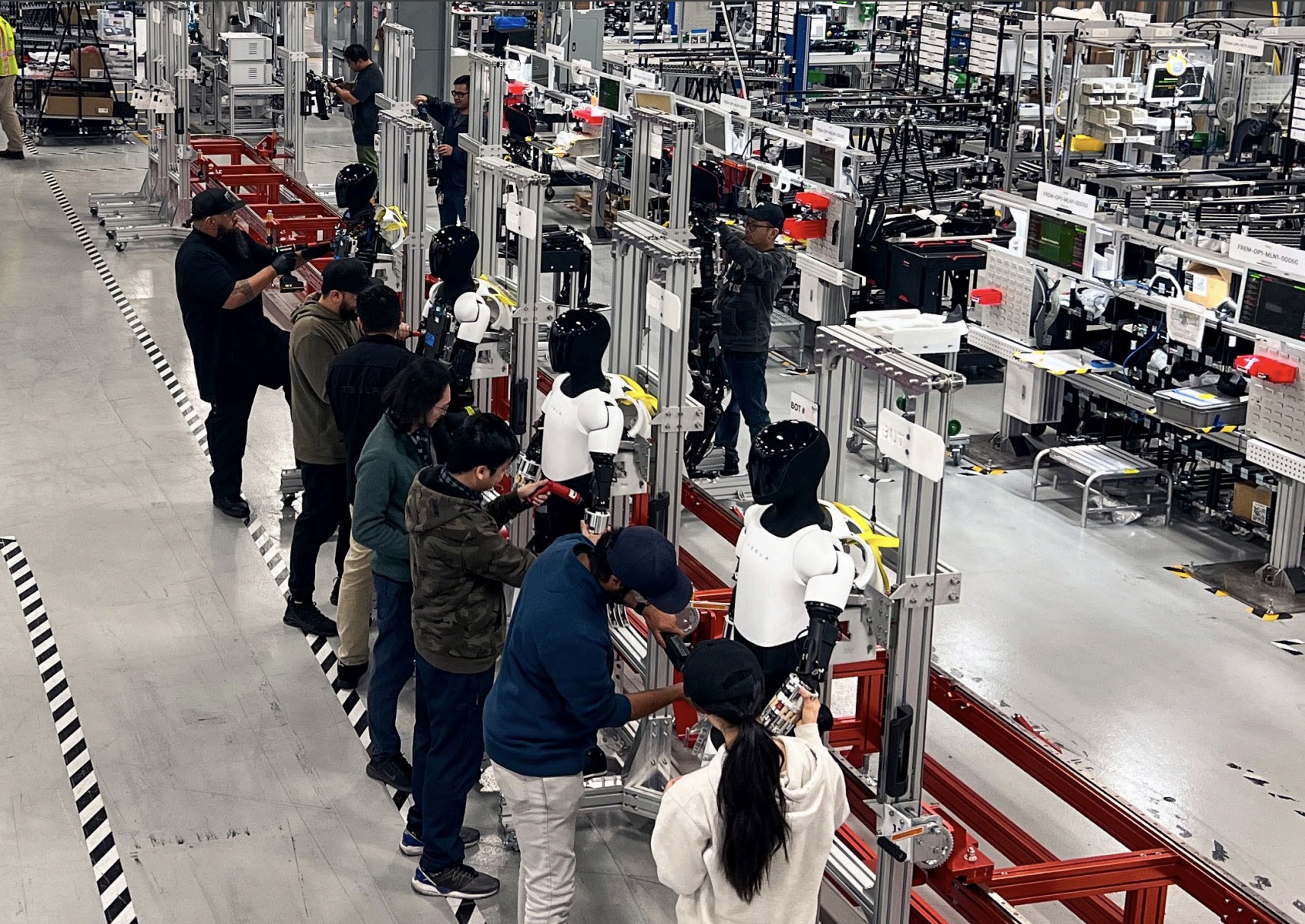
Mass production: Jan 21, 2026Location: Fremont, CAModel S/X lines convertedBody: Gen 2 (173cm, 57kg)
Tesla Optimus production line Fremont
JAN 222026
Sales Timeline
Musk Sets Public Consumer Sales Date: End of 2027
Reported by Bloomberg January 22: Musk stated Tesla will likely sell Optimus to the public by end of 2027, with the robot capable of handling complex tasks by end of 2026. The clearest public consumer sales commitment in the program's history. Analysts called 2026 "a defining year."
Complex tasks: end of 2026Consumer sales: end of 2027
JAN 282026
Earnings
Q4 2025 Earnings — $20B CapEx · Musk Admits Robots Not Yet Productive
Two headlines in direct tension:

The commitment: Tesla committed $20 billion in CapEx for 2026 — more than double the prior year. Targets confirmed: 10,000 units in 2025, 50,000 in 2026.

The candor: Musk acknowledged current units are "primarily for learning, not productive tasks" and confirmed the program is "still very much in the R&D phase." Notable honesty that tempered some of the mass production announcement momentum.
CapEx 2026: $20 billion2025 target: 10,000 units2026 target: 50,000 unitsMusk: "primarily for learning"
FEB 172026
Hardware Reveal
"This Bot Got Hands" — Full Gen 3 Hand System Revealed
Musk revealed the complete Gen 3 hand specs: 22 DOF per hand, 50 total actuators (25 per forearm/hand assembly). All actuators relocated from the hand into the forearm — a tendon-driven system replicating human forearm muscle anatomy: muscles in the human forearm pull tendons through the wrist to control finger joints. Tesla engineered this in silicon and steel.

Results: lightweight hand (moves faster), better heat dissipation, per-finger tactile feedback.

Tesla simultaneously released a Weibo video: Gen 3 acquiring skills by observing humans — trainable via demonstration, voice, or video. No teleoperation. No pre-programming.
22 DOF per hand50 total actuatorsForearm tendon drivePer-finger tactile feedbackLearns by observation
Tesla Optimus Gen 3 2026
MAR2026
Roadmap
Abundance Summit — Gen 4 Confirmed in Roadmap · 2029 Impact Vision
Musk briefly mentioned Optimus Gen 4 would follow Gen 3 — no specs, timeline, or pricing. He reiterated the long-term vision: Optimus starts changing lives in 2027, major impact by 2029. Planned capacity: 1 million units per year at Fremont, potential 10 million+ at future Giga Texas phases.
Gen 4 confirmed in roadmapMajor impact target: 2029Capacity: 1M+ units/year
Planned milestones ahead
Q2–Q32026
Planned
Low-Volume Production for Internal Use · First Dedicated Optimus Line
Mid-2026 target: low-volume production for internal Tesla factory deployment. First fully dedicated Optimus line at Fremont starts. Gen 3 hands performance in 24/7 factory conditions is the critical validation point analysts are watching most closely.
H22026
Planned
First External Enterprise Sales — Warehouse and Automotive Partners
First external commercial customers expected H2 2026 — likely warehouse operators and automotive manufacturers. Tasks: parts kitting, quality inspection, material handling. First time Optimus operates in an environment not controlled by Tesla.
Late2027
Planned
Consumer Sales Begin — Target $20,000–$30,000
Consumer sales targeted end of 2027. Fleet learning from thousands of deployed units dramatically accelerates task generalization. Price approaching $20–30K depends on manufacturing scale achieved through 2026–2027 ramp. Current est. unit cost: $50K–$100K.
Target: $20,000–$30,000Current est. cost: $50K–$100K

State of Optimus — March 2026

Mass production has commenced at Fremont with Gen 3 hands, $20 billion in CapEx committed, and a consumer sales date on the calendar. The honest picture: Musk's own Q4 earnings admission that units are "primarily for learning" means the operational threshold — robots doing genuinely productive work at scale — has not been crossed. The 2026 factory deployment results, and whether Gen 3 hands perform reliably in 24/7 conditions, will determine whether the 2027 consumer timeline holds.

Tesla, Optimus, Tesla Bot are trademarks of Tesla, Inc. Androids.com is independent. Data from Tesla earnings calls and verified press reporting. Updated March 2026.

Explore by Humanoid Brand

FIG · Figure AI, Inc. · Sunnyvale, CA

FIGURE
03

Figure's third-generation general-purpose humanoid robot — designed from the ground up for home environments and large-scale manufacturing. Purpose-built around the Helix vision-language-action AI and the first Figure platform engineered for high-volume production at BotQ.
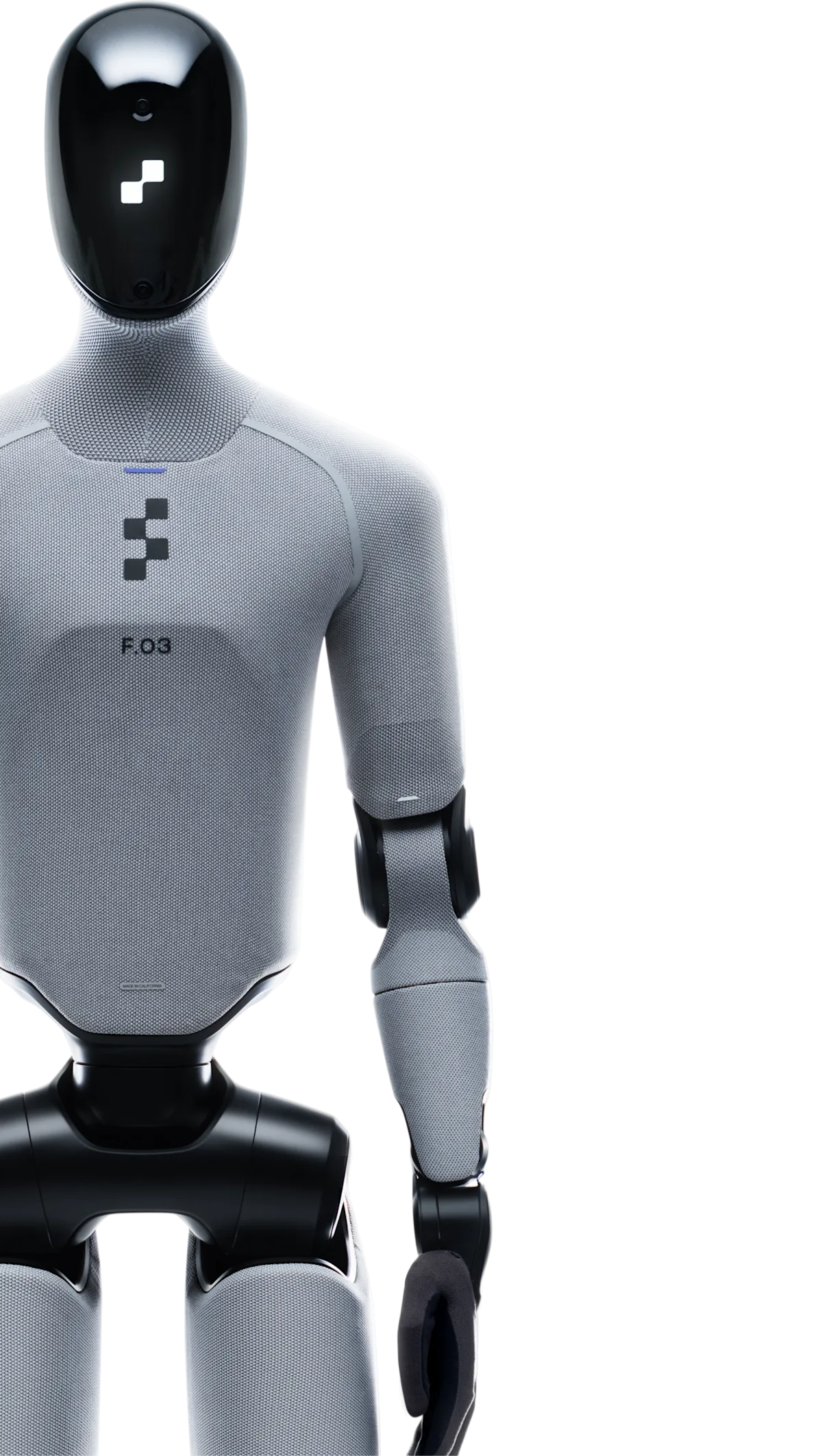
Humanoid / AI Home + Commercial Helix VLA AI Wireless Charging Not Yet Consumer Available
Figure 03 humanoid robot official image Select Deployments
Official Figure AI image · androids.com editorial use
5'6"
Height
20 kg
Payload
61 kg
Weight
5 hr
Runtime
1.2 m/s
Speed
01Technical Specifications
Height
5'6" (168 cm)
9% lighter & more compact than Figure 02
Weight
61 kg
134.5 lbs
Payload
20 kg
44 lbs carry capacity
Walking Speed
1.2 m/s
4.3 km/h · 2× faster actuators vs F.02
Runtime
5 hours
F.03 battery · UL safety cert targeted
Charging
Wireless 2 kW
Inductive via feet · step-on pad · no cables
Data Offload
10 Gbps
mmWave wireless · fleet learning between shifts
Cameras
8
6 main + 2 palm cameras · 2× frame rate vs F.02
Vision Latency
¼ of F.02
60% wider FOV per camera
Tactile Sensors
3 g detection
Fingertip force sensing · paperclip weight
AI System
Helix VLA
Vision-language-action · pixel-to-action
Power System
Electric
Custom F.03 battery pack
Target Price
~$25,000
Not available for consumer purchase · select partner deployments targeted late 2026 · early industrial est. $30K–$150K
Manufacturing
BotQ Facility
12,000 units/yr capacity · 100K over 4 years
02Generation Comparison
FIGURE 01
REVEAL · MAR 2023
Height5'6"
Hand DOFBasic manipulation
AIEarly autonomy stack
ChargingWired
BatteryCustom pack
StatusR&D / prototype
FIGURE 02
REVEAL · MAY 2024
Height5'6"
Hand DOF16 per hand · human-scale
AI6 RGB cameras · onboard VLM
ChargingWired · 2.25 kWh pack
Battery2.25 kWh · 50% more than F.01
StatusCommercial · BMW deployed
FIGURE 03
LAUNCH · OCT 2025
Height5'6" · 9% lighter than F.02
Hand DOFRedesigned · palm cameras
AIHelix VLA · 8 cameras · 3g tactile
ChargingWireless inductive 2 kW
BatteryF.03 pack · 5 hr runtime
StatusSelect partner deployments
03Helix AI System

Vision-Language-Action Intelligence

Helix is Figure's proprietary vision-language-action (VLA) model — the AI system that transforms raw camera input directly into robot actions without intermediate programming. Rather than following scripted routines, Helix perceives the environment, reasons about it, and generates motor commands in real time.

Helix learns new tasks by watching humans perform them on video. Figure demonstrated towel-folding capability with only 80 hours of training footage — dramatically faster than traditional robotics development. Tasks demonstrated include: folding laundry, loading dishwashers, clearing tables, loading laundry, and navigating home environments while responding to voice commands.

Helix 02, released January 2026, extends Helix to full-body autonomy — coordinating all limbs simultaneously for complex whole-body manipulation tasks.

80 hrs
Training for Towel Folding
vs months for traditional programming approaches
$39B
Post-money Valuation
Series C Sept 2025 · led by Parkway
100K
Robots Planned 4 Years
BotQ factory · 12,000/yr capacity
400%
Efficiency Gain at BMW
Figure 02 · 11-month Spartanburg deployment

Pixel-to-Action Learning

Helix processes raw camera pixels directly into motor commands. No intermediate 3D reconstruction, no scripted motion libraries — the model learns the full perception-to-action pipeline end-to-end from demonstration data.

Fleet Learning via mmWave

Every Figure 03 unit uploads sensor data at 10 Gbps wirelessly during shift breaks. Insights from one robot's experiences improve the entire fleet — the more units deployed, the smarter all of them become.

Voice Command Interface

Helix supports natural language instructions. Operators can tell the robot what to do conversationally, and it reasons about how to execute the task given its current environment — no code, no configuration.

Helix 02 — Full-Body Autonomy

Released January 2026, Helix 02 extends the VLA model to coordinate all joints simultaneously for complex whole-body manipulation — enabling tasks that require coordinated arm, torso, and leg movement at once.

04Home-Safe Design

Built for Human Environments

Figure 03 is the first humanoid designed from the beginning with home safety as a primary constraint — not an afterthought. Every design choice reflects the reality of operating around people, children, and fragile objects in unpredictable domestic spaces.

Soft Textile Exterior

The entire outer surface is covered in soft, washable knit textiles padded with multi-density foam. Eliminates pinch points and significantly reduces injury risk compared to hard robot exoskeletons. Coverings are machine washable and customizable for commercial deployments.

Compact Form Factor

9% lower mass and smaller volume than Figure 02. Designed to navigate household tight spaces — hallways, doorways, between furniture — without the clearance requirements of industrial-scale robots.

3-Gram Tactile Sensing

Proprietary fingertip sensors detect forces as light as 3 grams — approximately the weight of a paperclip. Enables handling of fragile objects, delicate fabrics, and irregular-shaped items without breakage or damage.

Wireless Everything

No charging cables to trip over. No data cables to disconnect. Figure 03 steps onto a charging pad, connects to Wi-Fi, and handles power and data management autonomously. Designed for continuous unattended operation in a home setting.

Side Display Screens

New side-mounted screens allow quick robot identification across large commercial fleets. Fully customizable for branding, operational status, or fleet management data. A safety and logistics feature for enterprise deployments.

UL Safety Certification Targeted

The F.03 battery system is being developed toward UL-standard safety certification — the first Figure platform to explicitly target consumer electronics safety standards, a prerequisite for home deployment at scale.

05Applications

What Figure 03 Does

Demonstrated Tasks
Laundry folding · dishwasher loading · table clearing · plant watering · room navigation
All via Helix AI · no teleoperation
Manufacturing
Parts handling · inspection · assembly
Follows Figure 02's BMW deployment model
Logistics
Warehouse picking · kitting
Primary commercial target for 2026 deployments
Home Use
Household chores · daily tasks
Primary design target · limited 2026 pilots
Education
Emerging
Melania Trump White House summit · March 2026
Voice Interaction
Multi-language
Greeted in 11 languages at White House

AVAILABILITY Q1 2026 — Figure 03 is not available for direct consumer purchase. Select partner deployments are underway. Broader home availability targeted for late 2026. Early industrial deployments range from $30K–$150K based on Figure 02 precedent. Consumer target price ~$25,000.

06Latest News
MAR 25
2026
Figure 03 Walks Into the White House Alongside Melania Trump
At Melania Trump's "Fostering the Future Together" education summit, Figure 03 became the first humanoid robot to enter the White House as a guest. It greeted attendees in 11 languages and introduced itself as "a humanoid built in the United States of America." Melania: "It's fair to state you are my first American-made humanoid guest in the White House."
Breaking
JAN 2026
Helix 02 Launched — Full-Body Autonomy
Figure released Helix 02, extending the VLA model to coordinate all joints simultaneously. Demos showed Figure 03 running with human-like precision alongside employees, powered by NVIDIA tech. CEO Brett Adcock predicted major 2026 breakthroughs in humanoids.
AI Update
NOV 2025
Figure 02 Completes 11-Month BMW Deployment — 30,000 Cars, 400% Efficiency
Figure 02 concluded its Spartanburg, SC deployment having contributed to the production of 30,000 cars, with 400% efficiency gains documented in specific tasks. Figure 02 began retirement as Figure 03 entered select deployments. A separate whistleblower lawsuit alleged safety risks, later contested by the company.
Milestone
OCT 2025
Figure 03 Officially Introduced — TIME Best Invention of 2025
Figure launched Figure 03 on October 9, 2025. Third-generation humanoid designed for Helix AI, home use, and large-scale deployment. Simultaneously named one of TIME's Best Inventions of 2025.
Launch
SEP 2025
$1B+ Series C Closes · $39B Valuation · Brookfield Partnership
Figure closed over $1 billion in Series C funding led by Parkway Venture Capital, with NVIDIA, Intel Capital, Qualcomm Ventures, and Salesforce participating. Post-money valuation: $39 billion. Simultaneously announced a strategic partnership with Brookfield and Project Go-Big for internet-scale humanoid pretraining.
Funding
AUG 2025
Helix Learns to Fold Laundry Autonomously
Helix demonstrated autonomous laundry folding — a key milestone in dexterous home task manipulation. The capability was achieved with 80 hours of training footage, dramatically faster than traditional robotics development approaches.
AI Milestone
MAR 2025
BotQ Manufacturing Facility Opens — 12,000 Units/Year Capacity
Figure introduced BotQ, a dedicated high-volume manufacturing facility designed to produce up to 12,000 humanoid robots per year. Shifted the company from prototype machining to scalable production. Target: 100,000 robots over four years.
Production

Full development history → Figure AI Development Timeline →
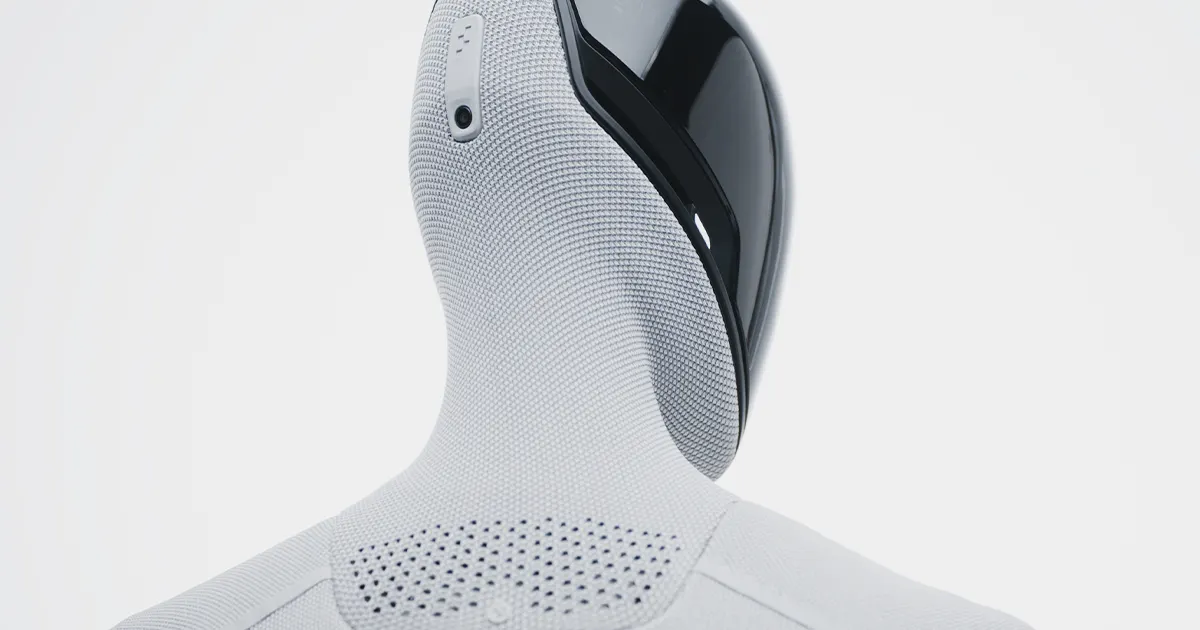
08Sources

Figure, Figure 03, Figure AI, and all related trademarks are property of Figure AI, Inc. Androids.com is independent and not affiliated with Figure AI. Specs compiled from official announcements and verified press reports. Updated March 2026.

Figure, Figure 03, and related trademarks are property of Figure AI, Inc. Updated March 2026 · androids.com
FIG · Development Timeline · Part 1 of 3

FIGURE AI
2021 – 2022

The founding years — from Brett Adcock's vision of a commercially viable general-purpose humanoid, through the company's formation and the first year of intensive hardware and AI development. The period before any public reveal.

2021
Founded
40
Initial team size
6
Months to first build
2022
Stealth period

Part 1 Context — 2021 to 2022

Figure AI was founded in 2021 by Brett Adcock, a serial entrepreneur who had previously co-founded Archer Aviation and Vettery. Adcock's thesis: the world needed a commercially viable, general-purpose humanoid robot — and no company was building one with the right combination of hardware expertise, AI capability, and manufacturing discipline. Figure assembled a team of 40 engineers from industry leaders including Boston Dynamics, Tesla, and Apple. By the end of 2022, the company had a full-scale robot build underway and was preparing to emerge from stealth.

2021
Company Founded
Figure AI incorporated with a clear mission: build the world's first commercially viable general-purpose humanoid robot, purpose-designed to address labor shortages and eliminate unsafe or undesirable jobs. The company begins assembling its founding team in stealth.
2021Founded
Founding Moment
Brett Adcock Founds Figure AI — "Commercially Viable" Humanoid Mission
Figure AI is incorporated by Brett Adcock, co-founder of Archer Aviation (electric aircraft) and Vettery (AI recruiting). Adcock's thesis: humanoid robots would become the largest product category in history, but no company was building one with a path to commercial viability and mass production.

The company's mission from day one: design a general-purpose humanoid robot capable of performing dangerous, repetitive, or undesirable jobs that currently require human workers. Target markets: manufacturing, logistics, warehousing, retail — industries with severe and growing labor shortages.

The company begins building in stealth, recruiting engineers from Boston Dynamics, Tesla, Apple, and other top robotics and technology companies.
Company founded Founder: Brett Adcock Location: Sunnyvale, CA Mission: Commercially viable humanoid
2022
Stealth Development · First Build
Figure assembles a team of 40 engineers and completes the first full-scale humanoid build in six months — an extraordinary pace for hardware of this complexity. The company remains in stealth through the end of 2022, preparing for a public reveal in early 2023.
2022Stealth
Hardware
40-Person Team Completes First Full-Scale Humanoid Build in 6 Months
Figure's founding team of 40 industry experts — drawn from Boston Dynamics, Tesla, Google, Archer Aviation, and other leading technology organizations — completes the first full-scale humanoid robot build in approximately six months. This pace is exceptional: most humanoid programs take years to reach a full-body prototype.

The build is completed in stealth. Figure is preparing for initial testing and a public reveal, focusing on validating the mechanical systems and establishing the AI data pipeline needed for autonomous operation. The company is not yet seeking commercial customers or public funding at scale — this period is pure engineering execution.
First full-scale build completed Team: 40 engineers Timeline: ~6 months to build Status: Still in stealth
LATE
2022
Pre-reveal
Strategy
Preparing for Public Emergence — Testing and Commercial Planning
With the first build complete, Figure begins testing in its Sunnyvale facilities. The team focuses on two parallel tracks: validating the robot's mechanical systems for basic locomotion and manipulation, and planning the commercial strategy for the public reveal planned for early 2023.

Figure's approach differs from academic or research robotics programs: the company is explicitly targeting commercial deployment as the primary goal, not research publication or engineering demonstration. This influences every design choice — the robot is designed to be useful in real industrial environments from the beginning, not optimized for laboratory benchmarks.
Testing: Sunnyvale facility Focus: Commercial viability Public reveal planned: early 2023

What 2021–2022 Established

By the end of 2022, Figure AI had accomplished something rare: an entire first-generation humanoid robot built from scratch by a startup in under a year. The founding team's depth — drawn from the best robotics programs in the world — was the primary asset. Brett Adcock's execution focus, the commercial-first design philosophy, and the 40-person team's speed set Figure apart from the academic and research robotics programs that had preceded it. The company entered 2023 ready to show the world what it had built.

Figure, Figure AI, and related trademarks are property of Figure AI, Inc. Androids.com is independent. Updated March 2026.
FIG · Development Timeline · Part 2 of 3

FIGURE AI
2023 – 2024

The breakout years — from emerging stealth to the world's first commercially deployed humanoid in a major factory. Figure 01 takes its first steps, the OpenAI partnership transforms the AI stack, and Figure 02 ships to BMW Spartanburg.

$675M
Series B raised
$2.6B
Valuation by Mar 2024
BMW
First commercial customer
16
Hand DOF — Figure 02
OpenAI
AI partnership

Part 2 Context — 2023 to 2024

2023 and 2024 are the years that took Figure from a stealth startup to the most talked-about humanoid robotics company in the world. Figure 01 emerged from stealth, took its first steps, won Intel Capital investment, and began commercial planning. Then 2024 delivered in rapid succession: an OpenAI partnership, a $675M raise backed by Jeff Bezos, Microsoft, and NVIDIA, the debut of Figure 02 with 16-DOF hands — and the first real-world commercial deployment at BMW. By end of 2024, Figure was shipping humanoid robots to a Fortune 500 paying customer.

2023
Figure 01 · First Steps · Intel Investment
Figure emerges from stealth and introduces Figure 01 to the world. The robot takes its first walking steps, attracts its first institutional investment, and begins the commercial planning that will culminate in the BMW partnership.
MAR2023
Public Launch
Figure Emerges from Stealth — Figure 01 Unveiled as World's First Commercially Viable General-Purpose Humanoid
Figure AI emerged from stealth in March 2023, unveiling Figure 01 to the public. The company positioned it as the world's first commercially viable general-purpose humanoid robot — a robot capable of thinking, learning, and interacting with its environment, specifically designed to address labor shortages and eliminate unsafe or undesirable jobs.

The team of 40 engineers completed the full-scale humanoid build in six months before emerging publicly. The reveal included Figure's commercial vision: deploying robots in manufacturing, shipping, logistics, warehousing, and retail — industries with severe and worsening labor shortages. Figure 01 stood approximately 5'6" and was capable of lifting up to 44 pounds (20 kg).
Public launch · stealth ended Height: 5'6" · Payload: 44 lbs Mission: Commercial viability
MAY 202023
Hardware Milestone
Figure 01 Takes Its First Walking Steps — One-Year Anniversary
On May 20, 2023 — Figure AI's one-year anniversary — Figure 01 took its first walking steps. The milestone was celebrated publicly and marked a significant technical achievement. The Figure team, which included engineers from Boston Dynamics and Tesla, had achieved bipedal locomotion in a commercially designed platform within its first year of existence. The B build of Figure 01 was expected by July and operational by September.
First walking steps achieved Date: May 20, 2023 Team: ex-Boston Dynamics, Tesla engineers
JUL2023
Investment
Intel Capital Invests $9M — First Institutional Funding
Intel Capital announced a $9 million equity investment in Figure AI in July 2023. This was Figure's first significant institutional investment, validating the commercial direction and providing capital to accelerate Figure 01's development and the AI data pipeline for autonomous operations. The investment came shortly after Figure 01's first walking milestone, signalling investor confidence in the team's technical execution speed.
Intel Capital: $9M investment Purpose: Accelerate Figure 01 + AI pipeline
SEP2023
Development
Alpha Build Testing — Second-Generation Robot in Planning
Figure continued testing the alpha build in its Sunnyvale offices through September 2023. The company focused on validating Figure 01 in commercial operations as a critical milestone — the alpha build needed to demonstrate it could perform real tasks reliably before commercial deployment. Simultaneously, the engineering team began planning a second-generation humanoid robot designed to be feature-complete for commercial operations from the start.
DEC2023
Development
Alpha Build Complete — Second-Gen Robot Development Underway
Figure completed the alpha build of Figure 01 and continued testing at its Sunnyvale facility through December 2023. The team was actively developing the second-generation humanoid, with a focus on making it fully feature-complete for commercial operations. The commercial partnership pipeline was building — the BMW agreement that would be announced in January 2024 was in negotiation by this point.
2024
OpenAI · $675M · Figure 02 · BMW Deployment
2024 is Figure's breakout year. A $675M Series B backed by the biggest names in tech, an OpenAI partnership that transforms the AI stack, Figure 02 with 16-DOF hands, and the first real commercial deployment of a humanoid robot inside a BMW factory. By December, Figure is shipping to paying customers.
JAN2024
Partnership
Commercial Agreement with BMW — First Commercial Customer Signed
Figure AI announced a commercial agreement with BMW Manufacturing to deploy general-purpose robots in automotive production environments. The agreement specifically targeted automating difficult, unsafe, or tedious manufacturing tasks, allowing employees to focus on more complex work. BMW's Spartanburg, South Carolina facility was the designated deployment site. This was Figure's first commercial customer — establishing the company as a serious industrial robotics player before any robot had been delivered.
First commercial customer: BMW Site: Spartanburg, SC Focus: Manufacturing automation
FEB2024
Funding
$675M Series B Raised — Jeff Bezos, Microsoft, NVIDIA, OpenAI Back Figure
Figure AI closed a $675M Series B funding round — exceeding its initial $500M target. The investor list was extraordinary for a Series B: Jeff Bezos, Microsoft, NVIDIA, and OpenAI all participated, alongside other institutional investors. The pre-money valuation reached approximately $2 billion, rising to $2.6 billion post-money. The funding was aimed at accelerating Figure 01's development and deployment across manufacturing, logistics, and warehousing. The OpenAI involvement as an investor also set the stage for the partnership announcement that followed.
$675M Series B raised Investors: Bezos · Microsoft · NVIDIA · OpenAI Valuation: ~$2.6B post-money
MAR2024
AI Milestone
OpenAI Partnership Demo — Figure 01 Talks, Reasons, and Acts in Real Time
Figure demonstrated the first results of its OpenAI collaboration with a viral video: Figure 01 engaging in real-time conversation while performing tasks. The robot described what it saw, planned future actions, used common-sense reasoning, reflected on its memory, and explained its reasoning verbally — all in a single uninterrupted interaction.

All behaviors were learned, not teleoperated — a landmark distinction. The robot could insert a coffee capsule into a machine and press start after only 10 hours of watching demonstration videos. No explicit programming, no hand-coded sequences. This was the first public demonstration of a humanoid robot combining language reasoning with physical manipulation in a unified autonomous system.
First real-time reasoning + manipulation demo Not teleoperated · fully learned Coffee task: 10 hrs training video
MAY2024
Hardware Milestone
Figure 02 Introduced — 16-DOF Hands, 6 Cameras, 3× AI Inference Power
Figure officially introduced Figure 02, the second-generation humanoid robot. Key improvements over Figure 01:

Hands: New human-scale hands with 16 degrees of freedom and human-equivalent strength — enabling a far wider range of manufacturing and manipulation tasks.

Vision: Six RGB cameras with an onboard vision-language model for fast visual reasoning.

Compute: NVIDIA GPU-based modules offering 3× the AI inference power of Figure 01 — enabling fully autonomous task execution.

Battery: Custom 2.25 kWh pack — over 50% more energy than Figure 01, extending operational runtime significantly.

Figure 02 immediately began data collection and use-case training at BMW's Spartanburg facility.
Figure 02 launched Hand DOF: 16 per hand Compute: 3× AI inference vs F.01 Battery: 2.25 kWh Cameras: 6 RGB + onboard VLM
JUL2024
AI Partnership
NVIDIA Partnership — Omniverse Integration for Synthetic Training Data
Figure AI announced plans to leverage NVIDIA's full technology stack, including NVIDIA Omniverse, for synthetic data generation and AI model training. The partnership aimed to enhance Figure 02's autonomous capabilities in conversational AI and real-time decision-making. NVIDIA's GPU modules on Figure 02 provided the 3× inference power advantage over the first generation, and the Omniverse integration allowed realistic simulation environments to generate training data that transferred to real-world robot operation.
NVIDIA Omniverse integration Synthetic training data generation 3× inference power confirmed
AUG2024
Development
Figure 02 Advanced Features — Speech-to-Speech AI, High-Precision Vision
Figure 02 continued demonstrating its advanced feature set through August 2024: improved speech-to-speech capabilities for natural interaction, and high-precision AI-driven vision systems. Figure's stated commercial goal was to address labor shortages by integrating humanoid robots into various industries, with a commercialization target of 2026. The $675M Series B remained the primary funding source, signaling strong ongoing investor confidence.
DEC2024
Commercial Milestone
Figure 02 Ships to Paying Customers — Commercial Revenue Begins
Figure AI began shipping Figure 02 humanoid robots to paying customers in December 2024, marking the start of commercial revenue. BMW's Spartanburg plant was the primary deployment site, where robots performed manufacturing tasks. This made Figure AI the first company to ship a commercially sold general-purpose humanoid robot to an enterprise customer — a landmark in the humanoid robotics industry.

The deployment at Spartanburg would eventually span 11 months, contribute to the production of 30,000 cars, and document 400% efficiency gains in specific tasks — one of the strongest real-world performance results ever recorded for a humanoid robot in a production environment.
First commercial shipments begin Customer: BMW Spartanburg First humanoid robot shipped commercially
Figure 02 at BMW Spartanburg plant

Figure 02 · BMW Group Plant Spartanburg · Courtesy BMW Group

What 2023–2024 Established

By end of 2024, Figure had gone from emerging stealth to shipping humanoid robots to a Fortune 100 automotive manufacturer. The OpenAI collaboration produced the most compelling demonstration of humanoid AI reasoning seen publicly. The $675M raise from the biggest names in technology validated Figure's commercial direction. Figure 02 shipping to BMW proved that general-purpose humanoid robots could operate in real production environments — not just labs or staged demos. The stage was set for Figure 03 and Helix to take this to scale.

Figure, Figure AI, and related trademarks are property of Figure AI, Inc. Androids.com is independent. Updated March 2026.
FIG · Development Timeline · Part 3 of 3

FIGURE AI
2025 – 2026

The scale era — Helix VLA transforms the AI stack, BotQ opens for mass production, Figure 03 launches as TIME's Best Invention of 2025, a $1B+ Series C values the company at $39B, and Figure 03 walks into the White House alongside Melania Trump.

$39B
Valuation Sep 2025
12K
BotQ capacity/year
Oct 2025
Figure 03 launched
80 hrs
Helix towel folding
White House
Mar 25, 2026

Part 3 Context — 2025 to 2026

This is where Figure transitions from a well-funded startup shipping first-generation commercial robots into a company building toward mass deployment at scale. Helix — a vision-language-action model that learns from observation — becomes the central AI breakthrough. BotQ opens to manufacture robots at scale. Figure 03 launches as an entirely new platform purpose-built for Helix and home environments. A $1 billion-plus Series C at $39 billion valuation secures the financial runway. And on March 25, 2026, Figure 03 walks into the White House alongside the First Lady — becoming the most publicly visible humanoid robot in history.

2025
Helix · BotQ · Figure 03 · $39B
2025 is Figure's most consequential year. The Helix VLA model reaches laundry-folding capability with 80 hours of training. BotQ opens for high-volume production. Figure 03 launches in October. The Series C closes at $39B valuation. And Figure 02 completes its landmark BMW deployment.
JAN2025
Strategy
100,000 Robots Planned Over 4 Years · Safety Center Established
Figure AI announced plans to ship 100,000 humanoid robots over the next four years, focusing on manufacturing and logistics. The company also detailed the establishment of a Center for the Advancement of Humanoid Safety — addressing workplace safety risks proactively ahead of broad deployment. This was the first time Figure publicly committed to a specific volume target at a multi-year horizon.
100,000 robots target · 4 years Focus: Manufacturing + logistics Safety center established
FEB2025
AI Milestone
Helix VLA Released — Vision-Language-Action Model for Generalist Humanoid Control
Figure released Helix — a vision-language-action (VLA) model for generalist humanoid control. Unlike previous robotics AI approaches that required explicit programming or extensive teleoperation data, Helix learns directly from observation: the robot watches humans perform tasks on video and learns to replicate them.

Helix connects perception, reasoning, and motor control into a single end-to-end model — processing raw camera pixels directly into robot actions. Early demonstrations showed Helix accelerating real-world logistics tasks dramatically compared to previous programming approaches.
Helix VLA model launched Pixel-to-action learning Learns from observation
MAR2025
Production
BotQ Manufacturing Facility Opens — 12,000 Units/Year Capacity
Figure introduced BotQ — a dedicated high-volume manufacturing facility designed to produce up to 12,000 humanoid robots per year, with the goal of producing 100,000 total over four years. BotQ represented a fundamental shift from prototype machining to scalable production.

Instead of relying on contract manufacturers, Figure brought production of its most critical systems in-house. The facility features a proprietary Manufacturing Execution System (MES) with full traceability from subassembly through final assembly. BotQ is designed for Figure 03 — the first Figure robot engineered from the ground up for high-volume manufacturing.
BotQ opens Capacity: 12,000 robots/year Target: 100,000 over 4 years In-house manufacturing control
JUN2025
AI Update
Helix Scales to State-of-the-Art Performance in Humanoid Logistics
Figure announced scaling of Helix to new state-of-the-art performance in humanoid logistics tasks. The model demonstrated significantly improved task completion rates and generalization across varied environments — moving from initial capability demonstrations to performance levels relevant for commercial deployment at logistics customers.
AUG 122025
AI Milestone
Helix Learns to Fold Laundry — 80 Hours of Training Video
Figure demonstrated Helix autonomously folding laundry — one of the most symbolic milestones in home robotics. The capability required only 80 hours of human demonstration video — dramatically faster than traditional robotics programming approaches. The demonstration covered multiple types of laundry items and handling techniques, including towels and clothing.

This milestone was widely covered by CNET, The Robot Report, and major technology media as the clearest public demonstration of Helix's practical home-task capability.
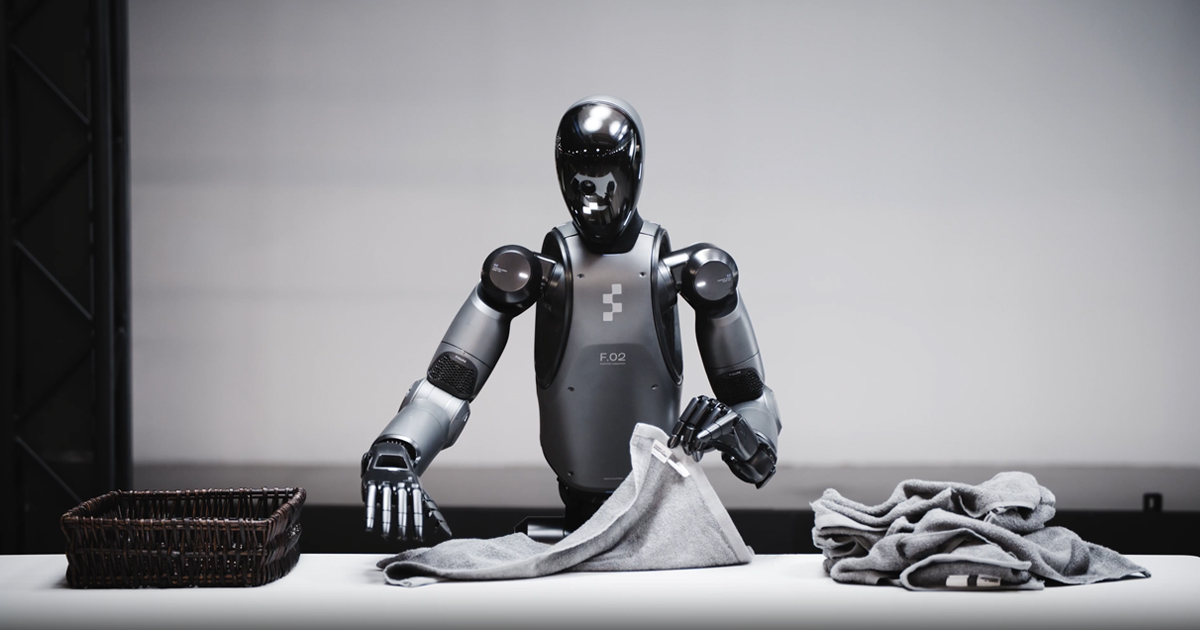
Autonomous laundry folding demonstrated Training data: 80 hours of video No teleoperation · fully learned
Helix folding laundry
SEP2025
Funding
$1B+ Series C Closes — $39B Post-Money Valuation · Brookfield Partnership · Project Go-Big
Figure closed over $1 billion in Series C funding led by Parkway Venture Capital, with NVIDIA, Intel Capital, Qualcomm Ventures, and Salesforce participating. Post-money valuation: $39 billion — making Figure AI one of the highest-valued private robotics companies ever.

Simultaneously: a strategic partnership with Brookfield for real estate and logistics deployments, and the announcement of Project Go-Big — Figure's initiative for internet-scale humanoid pretraining and direct human-to-robot transfer, aimed at dramatically accelerating the speed at which Helix learns new tasks by training on internet-scale video data.
$1B+ Series C closed $39B post-money valuation Investors: NVIDIA · Intel · Qualcomm · Salesforce Project Go-Big: internet-scale pretraining
OCT 92025
Product Launch
Figure 03 Officially Introduced — TIME's Best Invention of 2025
Figure launched Figure 03 on October 9, 2025. The third-generation humanoid was purpose-built around three goals: enable true Helix AI reasoning in the world, design for home environments, and manufacture at scale via BotQ.

Key advances over Figure 02: wireless inductive charging (feet on pad), 8 cameras including palm-mounted cameras, tactile fingertip sensors detecting 3-gram forces, soft washable textile exterior, 9% lighter and more compact body, 2× faster actuators, 10 Gbps mmWave data offload, and side display screens for fleet management.

Figure 03 was simultaneously named one of TIME Magazine's Best Inventions of 2025 — the first humanoid robot to receive the recognition.
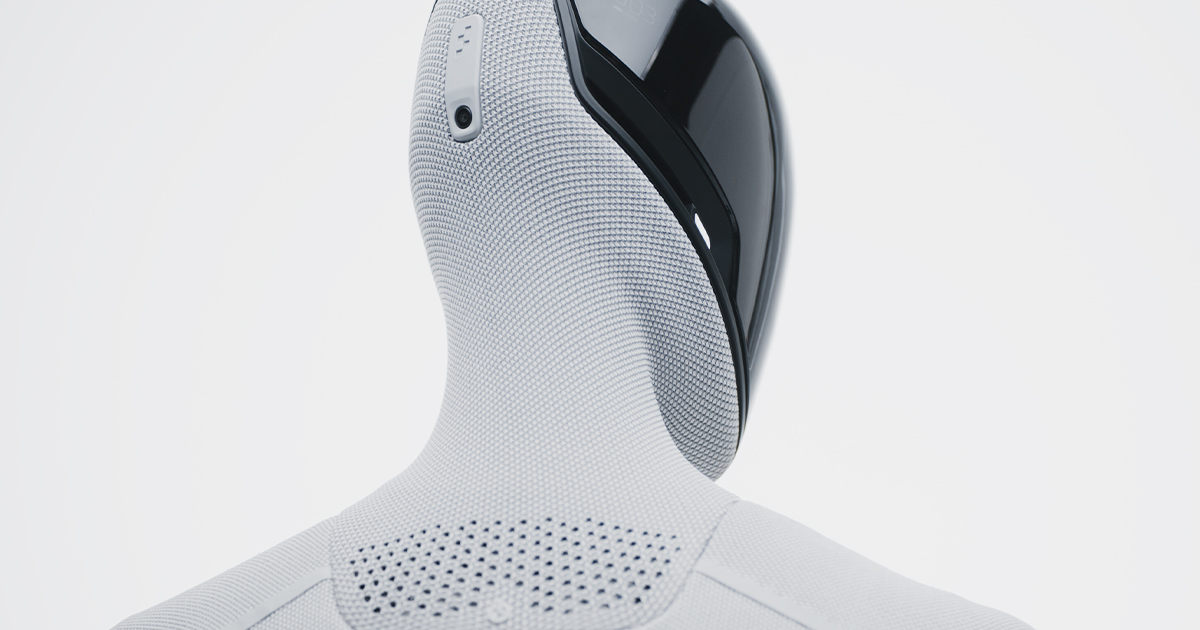
Figure 03 launched Oct 9, 2025 TIME Best Invention of 2025 Wireless charging · 8 cameras · 3g tactile 9% lighter than F.02
Figure 03 launch Oct 2025
NOV 192025
Commercial Milestone
Figure 02 Completes BMW Deployment — 30,000 Cars, 400% Efficiency Gains
Figure 02 concluded its 11-month deployment at BMW's Spartanburg plant, having contributed to the production of 30,000 cars and documenting 400% efficiency gains in specific tasks — one of the strongest real-world performance results recorded for any humanoid robot. Figure 02 robots were retired from active deployment as Figure 03 began taking over select deployments.

A separate whistleblower lawsuit in November 2025 alleged safety risks during the BMW deployment period; Figure contested the claims. The core deployment results — 30,000 cars, 11 months, 400% efficiency — remained the headline commercial data point.
11-month BMW deployment complete 30,000 cars produced 400% efficiency gains documented
2026
Helix 02 · White House · Scale
2026 opens with Helix 02 extending full-body autonomy to all joints simultaneously. By March 25, Figure 03 becomes the first humanoid robot to enter the White House — the most globally visible moment in the company's history.
JAN 272026
AI Update
Helix 02 Released — Full-Body Autonomy Across All Joints Simultaneously
Figure released Helix 02, extending the VLA model to coordinate all joints simultaneously for complex whole-body manipulation tasks. Demonstrations showed Figure 03 running with human-like precision alongside employees, powered by NVIDIA technology. CEO Brett Adcock predicted major 2026 breakthroughs in humanoid capabilities across commercial and consumer settings. Videos showing outdoor running were also released, demonstrating locomotion advances beyond the factory floor.
Helix 02 released Full-body autonomy · all joints Outdoor running demonstrated
MAR 252026
Breaking · Historic
Figure 03 Enters the White House — First Humanoid Robot as a White House Guest
On March 25, 2026, Figure 03 became the first humanoid robot to enter the White House as a guest, walking alongside First Lady Melania Trump at the "Fostering the Future Together Global Coalition Summit" in the East Room.

Figure 03 greeted attendees in 11 different languages, waved its hand, and introduced itself as "a humanoid built in the United States of America." Melania Trump said: "Figure 03, thank you for joining me. It's fair to state you are my first American-made humanoid guest in the White House."

The summit, focused on technology and children's education, was attended by first ladies of France, Sierra Leone, and Poland. Melania pitched a vision of robots as future educators. The footage went viral globally, accumulating hundreds of thousands of views within hours.

Figure AI had no active government contracts at the time. CEO Brett Adcock confirmed the appearance represented a significant endorsement for the company's US-built robotics mission.
First humanoid in the White House Greeted in 11 languages Event: Fostering the Future Together Summit Melania Trump: "my first American-made humanoid guest" Global viral reach · hundreds of thousands of views

State of Figure AI — March 2026

As of March 2026, Figure AI is the best-funded humanoid robotics company in the world at $39 billion valuation, with a dedicated manufacturing facility, a production-ready AI stack (Helix 02), and the most globally visible humanoid robot on the planet. The commercial track record — 30,000 BMW cars, 400% efficiency gains — is the strongest real-world performance data in the industry. Figure 03 is not yet available for consumer purchase, but select partner deployments are underway, and the company is targeting broader home availability for late 2026. The White House moment elevated public awareness of Figure and humanoid robotics globally in a single afternoon.

Figure, Figure AI, and related trademarks are property of Figure AI, Inc. Androids.com is independent. Data sourced from official announcements and verified press reporting. Updated March 2026.

Explore by Humanoid Brand

UTR · Unitree Robotics · Hangzhou, China

UNITREE
HUMANOIDS

The world's most affordable humanoid robot lineup — R1 at $4,900, G1 at $13,500, H2 at $29,900, H1 at $90,000. Founded by Wang Xingxing in 2016, Unitree holds ~70% of global quadruped robot sales and shipped 5,500+ humanoid units in 2025. IPO targeting Q2 2026 at a $7B valuation.

$4,900
Cheapest humanoid (R1 Air)
5,500+
Humanoids shipped 2025
70%
Global quadruped share
$140M
Annual revenue
$7B
IPO target valuation
01Current Humanoid Lineup
Unitree R1
R1
AI Avatar · Multimodal Humanoid
$4,900
R1 Air · from $5,900 R1
World's cheapest humanoid · TIME Best Invention 2025

The R1 is Unitree's entry-level humanoid — the most affordable full humanoid robot from any major manufacturer worldwide. Integrates multimodal large language models for voice and image understanding out of the box. Available in three variants: R1 Air ($4,900), R1 ($5,900), and R1 EDU (contact sales). Shipments began April 2026.

Height
1230 mm (4'0")
Weight
~25 kg (Air) / ~29 kg
Total Joints
20 / 26 / 26–40
Price (Air)
$4,900
Price (R1)
$5,900
AI
Multimodal LLM + Vision
Unitree G1
G1
Compact Humanoid · AI Avatar
$13,500
G1 standard · EDU up to $27,000
Best-selling humanoid · 5,000+ units shipped H1 2025

The G1 is Unitree's most popular humanoid platform — the best-selling humanoid robot from any manufacturer by volume. Compact at 127 cm, with extra-large joint movement range and optional 43-DOF configuration including force-control dexterous hands. Designed for imitation and reinforcement learning via NVIDIA Sim2Real. Performs backflips, dancing, martial arts, Tai Chi, and boxing in demonstrations.

Height
~1270 mm (4'2")
Weight
~35 kg (77 lbs)
Joint Motors
23–43 DOF
Walking Speed
~2.0 m/s
Hands (EDU)
Dex3-1 · 7 DOF/hand
Price
$13,500
Unitree H2
H2
Destiny Awakening · Service Humanoid
$29,900
H2 commercial · EDU: contact sales
Launched Oct 2025 · Bionic face · 2070 TOPS

The H2 is Unitree's full-size flagship humanoid for service environments. At 182 cm and 70 kg with a bionic dual-eye camera face, it is Unitree's most human-like robot. Features 31 DOF, 360 N·m max leg torque, and a 2070 TOPS onboard AI chip. Delivered its Spring Festival Gala 2026 debut as a "Sword Grandmaster" performing choreographed martial arts. Shipping from April 2026.

Height
1820 mm (5'11")
Weight
~70 kg (154 lbs)
Total DOF
31
Max Leg Torque
360 N·m
AI Chip
2070 TOPS
Waist DOF
3
Unitree H1
H1
Universal Humanoid · Research Platform
$90,000
Listed · contact for real price
China's first running humanoid · 3.3 m/s world record

The H1 was China's first full-size general-purpose humanoid robot capable of running — it held the world speed record at 3.3 m/s and was the first full-size robot to perform a standing backflip. The H1 and the H1-2 (heavier, with expanded arm and ankle DOF) share an official product page. Target market: universities, research labs, state-owned enterprises. BYD and Geely have piloted H1 on production lines.

H1 Height
~1800 mm (5'11")
H1 Weight
~47 kg (103 lbs)
Max Speed
3.3 m/s (world record)
Battery
864 Wh
H1-2 Weight
~70 kg · 27 DOF
Sensors
3D LiDAR + Depth Cam
02Side-by-Side Comparison
Spec R1 Air G1 H2 H1
Price$4,900$13,500$29,900$90,000*
Height1230 mm~1270 mm1820 mm~1800 mm
Weight~25 kg~35 kg~70 kg~47 kg
Total DOF2023–4331varies
Max Speed~2.0 m/s3.3 m/s (record)
Max Leg Torque360 N·m360 N·m
AI ChipMultimodal LLM2070 TOPS
SensorsVision + VoiceVision + optionalBionic dual-eye cams3D LiDAR + depth
Battery~2 hrs use864 Wh
Waist DOFoptional3
Head DOF22
Dexterous HandsNoOptional EDUOptionalOptional
Target MarketConsumer/DevResearch/EduService/IndustryEnterprise/Research
ShippingApr 2026AvailableApr 2026Available

*H1 listed at $90,000 with "contact for real price." All specs from official Unitree pages. — = not publicly disclosed.

03Company Overview

Wang Xingxing's Price-Breaking Machine

Unitree Robotics (Hangzhou Yushu Technology Co., Ltd.) was founded on August 26, 2016 by Wang Xingxing — a post-90s engineer who built his first quadruped robot, XDog, as a master's thesis project at Shanghai University in 2013. Wang left DJI to start Unitree in a 50 square meter office in Hangzhou's Binjiang District.

The company's defining competitive advantage is vertical integration: 90%+ of components — motors, reducers, encoders, sensors — are developed and manufactured in-house. This is why Unitree's prices are 30–50% below competitors. The company has been profitable every year since 2020, generated over ¥1 billion (~$140M) in annual revenue, and holds approximately 70% of global quadruped robot sales.

In 2025, Unitree raised a Series C round at approximately $1.7 billion valuation, backed by Alibaba, Tencent, China Mobile, Ant Group, Geely Capital, and HongShan Capital. In March 2026, Unitree received approval for an IPO on Shanghai's STAR Market to raise $610 million, targeting a $7 billion valuation.

NOTABLE: Wang Xingxing was the only entrepreneur of his generation invited to a February 2025 symposium of business leaders chaired by President Xi Jinping, seated in the front row near Huawei's Ren Zhengfei — a significant signal of Unitree's strategic importance to China's technology ambitions.

04AI & Technology Stack

Sim2Real + NVIDIA + Open Source

Unitree trains its humanoids using NVIDIA's technology — digital twins learn movements through trial and error in simulation, then the behaviors are transferred to physical robots via Sim2Real. In 2026, Unitree released two open-source AI frameworks: UnifoLM-WMA-0 (a world-model-action architecture for predicting and adapting to future environmental states) and UnifoLM-VLA-0 (a vision-language-action framework combining visual perception, natural language understanding, and robotic action).

Sim2Real Training

Digital twins train in NVIDIA simulation environments, then behaviors transfer to physical hardware. Has produced viral demonstrations of G1 performing backflips, martial arts, Tai Chi, and boxing — all learned, not hand-programmed.

UnifoLM-VLA-0 (Jan 2026)

Open-source vision-language-action model released January 29, 2026. Combines visual perception, natural language understanding, and robotic action in a single framework — enabling developers to build applications on top of Unitree hardware.

UnifoLM-WMA-0 (Sept 2025)

Open-source world-model-action architecture that allows robots to predict future environmental states and adapt behavior accordingly — enabling more generalizable autonomous operation in real environments.

R1 Multimodal LLM

The R1 integrates multimodal large models for voice and image out of the box — dramatically lowering the development threshold for the cheapest humanoid on the market. Developers can build on R1 independently without robotics expertise.

05Latest News
MAR 2026
IPO Approved — $610M Raise on Shanghai STAR Market · $7B Target Valuation
Unitree Robotics received approval for an IPO on Shanghai's STAR Market with CITIC Securities as lead underwriter, targeting a raise of $610 million (CNY 4.2 billion) at a $7 billion valuation. IPO expected Q2 2026. CEO confirmed 10,000–20,000 humanoid unit target for 2026.
IPO
FEB 2026
H2 at Spring Festival Gala — Sword Grandmaster + Monkey King in Armor
At the 2026 CCTV Spring Festival Gala (China's most-watched annual broadcast), H2 performed as a "Sword Grandmaster" at the Beijing main venue and appeared in Monkey King armor riding a B2W quadruped at the Yiwu sub-venue. Aerial flips, nunchaku, and Drunken Fist movements at up to 4 m/s — a major leap from 2025's performance.
Demo
JAN 2026
UnifoLM-VLA-0 Open-Source AI Framework Released
Unitree released UnifoLM-VLA-0 (January 29, 2026), an open-source vision-language-action framework. Combined with the H2's CES 2026 debut — live G1 boxing matches and H2 demonstrations at one of the most popular booths at the show.
AI
OCT 2025
H2 "Destiny Awakening" Unveiled — 182cm, Bionic Face, 2070 TOPS
Unitree unveiled the H2 humanoid on October 20, 2025. Standing 180cm tall, weighing 70kg, featuring bionic dual-eye cameras and a bionic face, with 31 DOF and a 2070 TOPS AI chip. Marketed as designed to "serve people." Commercial model at $29,900.
Launch
AUG 2025
World Humanoid Robot Games — 4 Gold Medals · H1 Sets 5+ m/s Speed Record
At the first World Humanoid Robot Games in Beijing (Aug 14–17), Unitree won four gold medals across 1500m, 400m, 100m obstacle race, and 4×100m relay — ranking first in gold and overall medals. H1 achieved a top speed exceeding 5 m/s. Independent G1 teams won 1 gold, 1 silver, 1 bronze.
Record
JUL 2025
R1 Launched at $4,900–$5,900 — World's Cheapest Full Humanoid
Unitree launched the R1 humanoid — R1 Air at $4,900, R1 at $5,900. Standing 1.2m, weighing 25kg, with 26 DOF and integrated multimodal AI. Named one of TIME's Best Inventions of 2025. Shipments began April 2026.
Launch
JUN 2025
Series C Closes — Alibaba, Tencent, China Mobile Back $1.7B Valuation
Unitree closed a Series C funding round backed by China Mobile, Tencent, Alibaba, Ant Group, Geely Capital, HongShan Capital, and Jinqiu Capital. Financing approached ¥700 million ($97.6M). Post-investment valuation exceeded ¥12 billion ($1.7B). Unicorn status confirmed.
Funding
FEB 2025
16 Unitree H1 Robots Star in CCTV Spring Festival Gala — "YangBot" Performance
On February 28, 2025, 16 Unitree H1 robots performed "YangBot" (秧Bot) at the CCTV Spring Festival Gala, directed by Zhang Yimou. The performance triggered a nationwide imitation trend and established Unitree as China's flagship robotics brand.
Cultural

Full development history → Unitree Development Timeline →

07Sources

Unitree, G1, R1, H2, H1, H1-2, and all related trademarks are property of Hangzhou Yushu Technology Co., Ltd. Androids.com is independent. Specs from official Unitree pages and verified press reports. Updated March 2026.

Unitree and all related trademarks are property of Hangzhou Yushu Technology Co., Ltd. Androids.com is independent. Updated March 2026.
UTR · Development Timeline · Part 1 of 3

UNITREE
2013 – 2022

From a master's thesis project to the world's dominant quadruped robot company — the origin story of Wang Xingxing, the XDog prototype, the founding of Unitree in 2016, and the decade of quadruped robotics that built the foundation for Unitree's humanoid ambitions.

2013
XDog prototype
Aug 2016
Unitree founded
70%
Global quadruped share
2020
Profitable

Part 1 Context — 2013 to 2022

Wang Xingxing was born in 1990 in Ningbo, Zhejiang. He assembled mini turbo jet engines in middle school and built model airplanes from childhood. Despite excelling at science, poor English grades nearly prevented him from entering high school and blocked elite university access. He studied at Shanghai University, where in 2013 he built the XDog — a quadruped robot using low-cost external rotor brushless motors. The project became an internet sensation.

Wang briefly worked at DJI, then resigned to found Unitree in August 2016. From a 50 square meter office in Hangzhou, he built a company that would become the world's dominant quadruped robot manufacturer — profitable every year since 2020 and holding approximately 70% of global quadruped sales by volume.

2013
XDog — The Origin
Wang Xingxing, a master's student at Shanghai University, builds the XDog quadruped as part of his thesis research. The prototype features custom-designed actuators, brushless motors, and a control architecture that emphasizes affordability without sacrificing performance. The project goes viral online.
2013Research
Origin Story
Wang Xingxing Builds XDog — Low-Cost High-Performance Quadruped Thesis
During his postgraduate studies at Shanghai University, Wang Xingxing independently developed the XDog — a quadruped robot using low-cost external rotor brushless motors with a full-degree-of-freedom actuation system. His work included custom motor drive board design, control architecture development, and simulation-based validation of gait dynamics.

XDog was not a typical academic project. Wang built it with the explicit goal of creating affordable, high-performance legged locomotion — not just demonstrating a concept. The robot attracted significant attention online and from investors, establishing Wang's reputation as a practical engineering talent rather than a pure academic researcher.

The design principles of XDog — maximize performance, minimize cost, manufacture everything in-house — became the founding philosophy of Unitree and explain why Unitree's robots cost 30–50% less than competitors to this day.
XDog built — viral internet response In-house actuators, motors, control system Philosophy: max performance, min cost
2016
Unitree Founded
After briefly working at DJI, Wang resigns to found Unitree in a 50 square meter Hangzhou office. The company begins selling quadruped robots publicly — establishing Unitree as the world's first company to offer high-performance quadruped robots at retail.
AUG 262016
Company Founded
Hangzhou Unitree Technology Co., Ltd. Registered — Wang Xingxing, CEO
Wang Xingxing registered and established Hangzhou Unitree Technology Co., Ltd. on August 26, 2016, in a 50 square meter office in Binjiang District, Hangzhou. The company's founding mission: produce and sell high-performance quadruped robots at prices accessible to developers, universities, and eventually consumers — not just defense and aerospace.

Unitree became the world's first company to publicly retail high-performance quadruped robots and the first to achieve broad industry deployment. The commercial strategy was radical for robotics: make the hardware cheap enough that researchers and developers would buy it without institutional procurement processes, then iterate based on real-world feedback from hundreds of deployed units.

Wang operated as both CEO and effective CTO — personally interviewing hires, working alongside engineers, and staying on the frontlines of product development. By early 2018, Unitree began receiving angel investment from formal institutions.
Founded Aug 26, 2016 Location: Binjiang District, Hangzhou First public retail high-performance quadruped CEO + CTO: Wang Xingxing
2018–2022
Global Quadruped Dominance
Unitree builds and consolidates its global quadruped leadership across five years. Formal investment begins in 2018, angel funding secures the growth runway, and quadruped sales reach 60–70% of global shipments. Key cultural milestones follow: 2021 CCTV Spring Festival Gala, 2022 Beijing Winter Olympics opening ceremony. Unitree turns profitable in 2020 — a year most robotics companies were burning cash.
2018Investment
Funding
First Formal Angel Investment — He Xiaopeng (XPeng) Among Early Backers
In 2018, Unitree began receiving angel investment from formal investment institutions. Early investors included Variable Capital under GeekPark, AnChuang Technology Investment, and Binhe Investment with He Xiaopeng (founder of XPeng, one of China's leading EV companies) as the main contributor. A seed round had already been secured from individual investor Yin Fangming (2 million RMB for 20% equity in the early days). These investments funded expansion beyond quadruped prototypes into commercial product lines.
Angel round closed 2018 Backer: He Xiaopeng (XPeng founder)
2020Milestone
Financial Milestone
Unitree Turns Profitable — Sustained Every Year Since
In 2020, Unitree achieved profitability — a rare milestone for a robotics hardware company at this stage. The company has remained profitable every year since 2020, with annual revenue eventually exceeding ¥1 billion (~$140 million). Profitability at scale reflects Unitree's core advantage: by manufacturing 90%+ of components in-house (motors, reducers, encoders, sensors), the company achieves margins unavailable to companies that source from external suppliers at list price.
Profitable from 2020 · every year since Revenue eventually exceeds $140M/year
FEB 2021Cultural
Cultural Moment
24 Unitree A1 Robots Perform at CCTV Spring Festival Gala with Liu Dehua
On February 11, 2021, 24 Unitree A1 robots — in the form of a "small bull" (犇犇) for the Year of the Ox — performed at the CCTV Spring Festival Gala alongside superstars Liu Dehua (Andy Lau), Wang Yibo, and Guan Xiaotong in the performance "Niu Qi Lai." This was the world's first four-legged robot dynamic walking cluster dance performance, and it triggered national conversation about Unitree's technology. China's most-watched annual broadcast became a platform for establishing Unitree as a household name.
CCTV Spring Festival Gala 2021 World's first cluster quadruped dance performance
FEB 4
2022
Cultural
Cultural Moment
109 Unitree Robots at Beijing Winter Olympics Opening Ceremony — Spelling "Winter Olympics"
On February 4, 2022, the Beijing Winter Olympics opening ceremony featured 109 Unitree "FuHu" (福虎) robots arranged in precise formation to spell "Winter Olympics" — delivering what was described as a "visual feast" to the world. The Winter Olympics opening ceremony is one of the most-watched televised events in history, and Unitree's participation in the show established the company's technology on a global stage — the largest coordinated robot performance ever staged at a major international sporting event.
Beijing Winter Olympics opening ceremony 109 Unitree robots · global broadcast
FEB 13
2023
Cultural
Cultural Moment
Unitree Go1 Performs with Jason Derulo at Super Bowl Pre-Game
On February 13, 2023, Unitree's Go1 robot performed with American superstar Jason Derulo during the Super Bowl pre-game show — one of the world's highest-viewership sporting events. The appearance marked Unitree's first major Western cultural moment, introducing the company's technology to a North American audience estimated at over 100 million viewers. It also established Unitree's entertainment and performance appeal beyond the Chinese market.
Super Bowl pre-game 2023 Performer: Jason Derulo 100M+ viewers

What 2013–2022 Established

By the end of 2022, Unitree had accomplished something no other robotics company had done: dominate global quadruped robot sales at consumer-accessible price points while remaining profitable. The company had performed on the world's biggest stages — CCTV Spring Festival Gala, Beijing Winter Olympics, Super Bowl — establishing cultural credibility alongside engineering excellence. Wang Xingxing's founding philosophy — manufacture everything in-house, maximize performance, minimize cost — had been validated at scale. Unitree entered 2023 ready to apply the same approach to humanoid robots.

Unitree and all related trademarks are property of Hangzhou Yushu Technology Co., Ltd. Androids.com is independent. Updated March 2026.
UTR · Development Timeline · Part 2 of 3

HUMANOID
2023 – 2024

Unitree's humanoid debut — China's first running humanoid H1 sets a 3.3 m/s world record, becomes the first full-size robot to backflip, then G1 launches at $16,000 and causes a global sensation. NVIDIA partnership, new 10,000 m² factory, Asian Games, and viral AI demonstrations.

H1
China's first running humanoid
3.3 m/s
H1 world speed record
G1
Launched $16,000
NVIDIA
Sim2Real partnership
10,000 m²
New Hangzhou factory

Part 2 Context — 2023 to 2024

2023 and 2024 mark Unitree's pivot from quadruped king to humanoid contender — and the results were immediate and dramatic. The H1 set a global running speed record, performed the world's first full-size robot backflip, and attracted global media attention. Then G1 launched at $16,000 — a price point that disrupted the entire humanoid market and triggered a Sim2Real viral campaign of dancing, boxing, and martial arts demonstrations that accumulated millions of views. By end of 2024, Unitree had shipped an estimated 5,000+ G1 units in the first half of 2025 alone — more than any other humanoid company at comparable pricing.

2023
H1 — China's First Running Humanoid
Unitree officially enters humanoid robotics on August 15, 2023 with the H1 — described as China's first full-size general-purpose humanoid robot capable of running. The H1 immediately sets a world record, then becomes the first full-size robot to perform a standing backflip. The Hangzhou Asian Games deployment follows — a second major global sports showcase in as many years.
AUG 152023
Hardware Launch
H1 Released — China's First Full-Size Running Humanoid · 3.3 m/s World Record
Unitree officially released the H1 on August 15, 2023 — "the first full-size universal humanoid robot that can run in China, and a major breakthrough in the application of bipedal robotics technology." The H1 was developed in approximately six months and entered mass production shortly after release — a production speed typical of Unitree's engineering culture.

Key specifications: approximately 1.8 meters tall, approximately 47 kilograms, high-torque joint actuators capable of up to 360 N·m, 3D LiDAR and Intel RealSense D435 depth camera, Livox Mid-360 panoramic sensing, and a modular architecture supporting ROS integration and OTA software updates.

The H1's 3.3 m/s running speed set a world record for bipedal humanoid robots at the time of release — a headline-grabbing achievement that immediately established Unitree as a serious humanoid manufacturer. Wang Xingxing famously appeared in footage kicking an H1 robot to demonstrate its balance recovery.
H1 released Aug 15, 2023 3.3 m/s — world speed record (at release) Height: ~1.8m · Weight: ~47 kg Torque: 360 N·m · Battery: 864 Wh Sensors: 3D LiDAR + depth camera
JUL 2023Product
Product Launch
Unitree Go2 Launched — AI Foundation Model Integration · 4D Ultra-Wide LiDAR
On July 12, 2023, Unitree launched the Go2 — a new generation consumer-grade quadruped robot featuring 4D ultra-wide-angle LiDAR as standard and empowered by AI foundation models. The Go2 represented a significant upgrade in sensing capability over predecessors and further solidified Unitree's dominance in the quadruped segment even as the company simultaneously developed humanoid hardware.
Go2 launched July 2023 4D ultra-wide LiDAR standard AI foundation model integration
OCT 2023Cultural
Cultural Moment
19th Asian Games Hangzhou — Unitree Robot Dogs Carry Discus and Javelin on Track
At the 19th Asian Games in Hangzhou — held in Unitree's home city — Unitree robot dogs were deployed to carry discus and javelin equipment on the track during field events. The robots entered the stadium in queues, performing synchronized movements before global sports broadcast audiences. The moment was described by viewers as "too futuristic" and widely circulated on Chinese and international social media. Appearing at a major international athletic competition in their home city reinforced Unitree's standing as China's flagship robotics brand.
19th Asian Games Hangzhou Unitree dogs on competition track
EARLY2024
Hardware Milestone
H1 Performs First Full-Size Electric Bipedal Standing Backflip in History
In early 2024, the H1 became the first full-size electric bipedal robot ever to perform a standing backflip. The achievement required solving extremely demanding balance recovery, torque output, and real-time control challenges. The video was widely distributed globally and set off a wave of coverage positioning Unitree alongside the most sophisticated humanoid programs in the world — despite being a company with far fewer resources than US competitors. This moment, combined with the 3.3 m/s speed record, made H1 one of the most recognized humanoid robots of 2023–2024.
World's first full-size bipedal backflip Solved: balance, torque, real-time control
2024
G1 Launch · NVIDIA · New Factory · Viral AI
2024 is Unitree's G1 year — and it triggers a global sensation. Launched on May 13 at $16,000, the compact humanoid becomes the most accessible high-performance humanoid ever offered. NVIDIA partners on Sim2Real training. A new 10,000 m² Hangzhou factory goes online. And G1 demonstrations of backflips, dancing, Tai Chi, and robot boxing go viral worldwide.
APR2024
Infrastructure
New 10,000 m² Hangzhou Factory Opens — Scaling for Humanoid Production
In April 2024, Unitree launched its new 10,000 square meter manufacturing facility in Hangzhou — approximately 1.5 football fields — to ramp up output ahead of the G1 launch and anticipated humanoid demand. The Hangzhou municipal government actively supported Unitree's establishment of the facility. The factory enabled the production scaling that would ultimately allow Unitree to ship 5,500+ humanoid units in 2025 at price points no competitor could match.
New 10,000 m² Hangzhou factory Municipal government support Purpose: Humanoid production scale
MAY 132024
Product Launch
G1 Humanoid Launched at $16,000 — "AI Avatar" · Causes Global Sensation
On May 13, 2024, Unitree introduced the G1 — described as a "humanoid agent, AI avatar." The G1 immediately caused a global sensation in robotics and AI fields. At approximately 127 cm tall and weighing 35 kg, it featured flexibility beyond what most humans could achieve, and at $16,000, it undercut every comparable humanoid platform by a factor of 2–10×.

The G1 offered 23 to 43 degrees of freedom depending on configuration — the EDU variant with Dex3-1 dexterous hands reaching 43 DOF including 7 DOF per hand. The robot integrated Unitree's custom actuator technology and leveraged the same high-torque joint modules as the quadrupeds, enabling both precise manipulation and dynamic locomotion.

The pricing disruption was intentional. By keeping motors, reducers, encoders, and sensors in-house, Unitree could offer humanoid capability at research-accessible price points — targeting universities, robotics startups, and eventually mid-size manufacturing companies that could never afford $90,000+ alternatives.
G1 launched May 13, 2024 $16,000 — disrupted humanoid pricing globally Height: 127 cm · Weight: 35 kg DOF: 23–43 depending on config EDU hands: 7 DOF/hand
MID2024
AI Partnership
NVIDIA Sim2Real Partnership — Digital Twins Train in Simulation, Transfer to Hardware
Unitree established a significant partnership with NVIDIA, using NVIDIA's technology stack for Sim2Real training — the process of training robot behaviors in a simulated digital twin environment and then transferring them to physical hardware. Using NVIDIA Omniverse, G1 digital twins learn movements through trial and error in simulation. The learned behaviors are then transferred to physical robots.

The NVIDIA Sim2Real approach is what enabled the viral G1 demonstrations of 2024: backflips, human-like dancing, Tai Chi routines, martial arts forms, and eventually robot boxing matches — all executed via reinforcement learning in simulation, not hand-programmed motion sequences. The partnership was featured at GTC 2024, where Unitree showcased its advancements alongside other leading humanoid companies.
NVIDIA Sim2Real partnership Digital twins train via reinforcement learning Enabled: backflips · dancing · martial arts · boxing
2024Viral
Viral Demonstrations
G1 Goes Viral — Backflips, Dancing, Tai Chi, Martial Arts, Robot Boxing
Throughout 2024, Unitree released a series of G1 demonstration videos that went viral globally, collectively accumulating millions of views across YouTube, X, and Chinese platforms:

Backflips: G1 performing standing backflips — extending the achievement Unitree first demonstrated with H1.
Human-like dancing: G1 executing complex dance routines with fluid, human-matching body movement.
Competitive Tai Chi: G1 performing full Tai Chi routines — demonstrating smooth, controlled articulation across all joints simultaneously.
Martial arts: Multiple forms including kicks, punches, and spinning techniques.
Robot boxing: Two G1 units fighting each other in a boxing match (demonstrated in May 2025 at the Robotics Summit in Boston).

Each demonstration was a direct result of the NVIDIA Sim2Real pipeline — behaviors trained in simulation and transferred to hardware. The videos established Unitree's G1 as the most capable-per-dollar humanoid robot in existence.
G1 viral video campaign 2024 Millions of combined views globally All via Sim2Real — not hand-programmed
AUG2024
Product
G1 Mass Production Begins at $16,000 — "Unlocks Unlimited Movement Potential"
In August 2024, Unitree released the G1 for mass production — confirming the commercial availability of the robot for developers, researchers, and eventually enterprises. Described officially as having "flexibility beyond ordinary people" and designed to "unlock unlimited movement potential," the G1 became accessible to universities and small labs that had never been able to afford comparable humanoid hardware. BYD and Geely were both reported to have piloted Unitree humanoids on production lines during this period.
G1 mass production begins Customers: universities · labs · BYD · Geely pilots
SEP2024
AI Release
UnifoLM-WMA-0 Open-Source World Model Released
In September 2025 (first announced in late 2024 planning), Unitree released UnifoLM-WMA-0 — an open-source world-model-action architecture. The framework allows robots to predict future environmental states and adapt behavior accordingly, enabling more generalizable autonomous operation across varied real-world conditions. The open-source release was part of Unitree's strategy to build an ecosystem of developers building on top of its hardware platforms.
UnifoLM-WMA-0 released Open-source world model architecture Environmental state prediction + adaptation

What 2023–2024 Established

By end of 2024, Unitree had demonstrated something that no Western humanoid company had: the ability to produce and ship a capable humanoid robot at a price that opened the market to universities, startups, and small manufacturers. The G1 at $16,000 forced a global repricing conversation. The NVIDIA Sim2Real partnership produced demonstrations that went viral across cultures and languages. The H1 world speed record and backflip achievement established Unitree's technical credibility. And the new Hangzhou factory positioned the company for the humanoid volume ramp that would come in 2025 — when Unitree would ship over 5,500 humanoid units and still hold the title of most affordable humanoid on the market.

Unitree and all related trademarks are property of Hangzhou Yushu Technology Co., Ltd. Androids.com is independent. Updated March 2026.
UTR · Development Timeline · Part 3 of 3

SCALE ERA
2025 – 2026

Unitree's most consequential year — 16 H1 robots direct-by Zhang Yimou at the CCTV Spring Festival Gala, the World Humanoid Robot Games (4 gold medals, 5+ m/s), the R1 at $4,900, the H2 "Destiny Awakening," a $1.7B Series C, 5,500+ units shipped, and IPO approval for $610M at a $7B valuation.

5,500+
Humanoids shipped 2025
4 Gold
World Humanoid Games
$4,900
R1 Air — cheapest humanoid
$1.7B
Series C valuation
$7B
IPO target valuation

Part 3 Context — 2025 to 2026

2025 is Unitree's most consequential year in humanoid robotics. The Spring Festival Gala performance — 16 H1 robots directed by Zhang Yimou — establishes Unitree as China's definitive robotics brand. The World Humanoid Robot Games delivers four gold medals and a new 5+ m/s speed record. The R1 becomes the cheapest humanoid on earth. The H2 "Destiny Awakening" is unveiled with a bionic face and 2070 TOPS AI chip. Series C closes at $1.7B valuation backed by Alibaba, Tencent, and China Mobile. And by the time Wang Xingxing speaks at Summer Davos, Unitree has shipped over 5,500 humanoid robots — more than any other company. 2026 opens with IPO approval.

2025
Spring Gala · World Games · R1 · H2 · Series C
A landmark year across every dimension — cultural, competitive, commercial, and financial. Every major milestone in 2025 reinforces the same thesis: Unitree is the highest-volume, most affordable, and most publicly visible humanoid company in the world.
FEB 282025
Cultural Milestone
16 Unitree H1 Robots at CCTV Spring Festival Gala — "YangBot" Directed by Zhang Yimou
On February 28, 2025, 16 Unitree H1 robots performed the "YangBot" (秧Bot) routine at the CCTV Spring Festival Gala — China's most-watched annual broadcast, with audiences in the hundreds of millions. The performance was directed by Zhang Yimou, China's most celebrated film director (known for the 2008 Beijing Olympics opening ceremony).

The fusion of Unitree's humanoid robots with traditional folk dance triggered an immediate nationwide cultural response. The performance broke through cultural barriers and "rapidly triggered a nationwide imitation trend," according to Unitree. It was the most prominent humanoid robot showcase in television history — watched by more people than any other robot performance ever staged.

The Spring Festival Gala appearance was also credited by investors with stimulating the final stages of Series C negotiations — directly linking cultural performance to financing outcomes.
16 H1 robots · CCTV Spring Festival Gala Director: Zhang Yimou Nationwide imitation trend triggered Contributed to Series C investor interest
FEB 2025Notable
Recognition
Wang Xingxing at Xi Jinping Symposium — Only Entrepreneur of His Generation
In February 2025, Wang Xingxing was the only entrepreneur of his generation invited to a high-profile symposium of business leaders chaired by President Xi Jinping. He was seated prominently in the front row, near tech luminaries including Huawei's Ren Zhengfei. The invitation confirmed Unitree's strategic importance within China's broader technology and industrial ambitions — and established Wang personally as one of China's most important technology figures of the post-90s generation. Chinese media dubbed him a "post-90s robotics genius."
Xi Jinping symposium · Feb 2025 Front row · alongside Ren Zhengfei (Huawei)
JUN2025
Funding
Series C Closes — Alibaba, Tencent, China Mobile, Ant Group, Geely, ByteDance Back $1.7B Valuation
Unitree closed its Series C financing on June 19, 2025. The round was led by funds under China Mobile, Tencent, Alibaba, Ant Group, Geely Capital, HongShan Capital (formerly Sequoia China), and Jinqiu Capital (ByteDance). Financing approached ¥700 million (~$97.6 million). Post-investment valuation exceeded ¥12 billion (~$1.7 billion), confirming unicorn status.

The round brought total confirmed funding to approximately $155 million across multiple rounds. Existing shareholders also participated. Reports explicitly credited the Spring Festival Gala H1 performance with stimulating investor interest in the final stages of negotiation — an unusual direct link between cultural performance and capital raise.
Series C closed June 2025 $1.7B post-investment valuation · unicorn Led by: China Mobile · Tencent · Alibaba Also: Ant Group · Geely · HongShan · ByteDance ~$97.6M raised
JUL2025
Product Launch
R1 Launched at $4,900–$5,900 — World's Cheapest Full Humanoid · TIME Best Invention 2025
Unitree launched the R1 in July 2025 — R1 Air at $4,900, R1 at $5,900 — the cheapest full humanoid robot offered by any major manufacturer on the planet. The R1 stands 1.2 meters tall, weighs approximately 25 kg (Air) or 29 kg (standard), and features integrated multimodal large language models for voice and image understanding out of the box.

The R1 Air's $4,900 price point undercut the G1 ($13,500) significantly and was made possible by Unitree's vertical integration: motors, reducers, and core components manufactured in-house. The R1 standard offers 26 joint modules (6 joints per leg ×2, 2 waist, 5 per arm ×2, 2 head). Launch demonstrations included side flips, handstands, and boxing moves.

TIME Magazine named the R1 one of its Best Inventions of 2025 — the same recognition given to Figure 03 in the same year. Shipments began April 2026.
R1 Air: $4,900 — cheapest humanoid ever TIME Best Invention of 2025 Height: 1.2m · Weight: 25 kg (Air) DOF: 26 standard · Multimodal LLM built-in Shipping: April 2026
AUG 14–172025
Competition
World Humanoid Robot Games — 4 Gold Medals · H1 Sets 5+ m/s Speed Record · First Overall
The first World Humanoid Robot Games were held in Beijing from August 14–17, 2025. Unitree dominated comprehensively, winning four gold medals across all major track disciplines: 1500m, 400m, 100m obstacle race, and 4×100m relay. Unitree ranked first in both the gold medal count and the overall medal tally.

The Unitree H1 achieved a top speed exceeding 5 meters per second during competition — surpassing its own 3.3 m/s world record by over 50% and setting a new benchmark for bipedal locomotion speed globally.

Additionally, independent teams using Unitree's G1 hardware platform won 1 gold, 1 silver, and 1 bronze medal in non-Unitree-entered events — demonstrating the platform's capability for third-party development. The Games established humanoid robot competition as a recurring international event and positioned Unitree as the undisputed performance leader.
4 gold medals — 1st overall H1 top speed: 5+ m/s (new world record) Events: 1500m · 400m · 100m obstacle · 4×100m relay G1 third-party teams: 1 gold · 1 silver · 1 bronze
AUG 52025
Product
A2 Quadruped Launched — 37 kg · 3hr Full Load / 5hr Empty · Redefines Industry Standards
On August 5, 2025, Unitree launched the A2 quadruped robot — weighing approximately 37 kg and capable of walking continuously for 3 hours (12.5 km) with full load and 5 hours (20 km) without load. Equipped with two industrial lidar sensors in the front and rear, an HD camera, and a front light, the A2 was described as "lighter, faster, and stronger, redefining a new paradigm for industry applications." The A2 launch reinforced Unitree's continued dominance in the quadruped market even as it built out the humanoid lineup.
A2 quadruped launched Aug 2025 37 kg · 3hr full load / 5hr empty Dual industrial lidar + HD camera
SEP2025
AI Release
UnifoLM-WMA-0 Open-Source World Model Released
In September 2025, Unitree released UnifoLM-WMA-0 — an open-source world-model-action architecture that allows robots to predict future environmental states and adapt behavior accordingly. The release was part of Unitree's strategy to build a developer ecosystem around its hardware — enabling third parties to build autonomous applications on top of H1, G1, H2, and R1 hardware platforms without building the prediction layer from scratch.
UnifoLM-WMA-0 released Sept 2025 Open-source · world model + action
OCT 202025
Product Launch
H2 "Destiny Awakening" Unveiled — 182 cm · Bionic Face · 31 DOF · 2070 TOPS
On October 20, 2025, Unitree unveiled the H2 humanoid, marketed as "Destiny Awakening." At 182 cm tall and 70 kg, with bionic dual-eye cameras and a bionic face designed to serve people, the H2 is Unitree's most humanlike robot to date.

Key specifications: 31 degrees of freedom, maximum leg torque of 360 N·m, 3 waist DOF, 2 head DOF, and a 2070 TOPS onboard AI chip — one of the most powerful embedded AI compute platforms in any humanoid robot. The commercial model was priced at $29,900; an EDU model is available via sales contact.

Stand footprint: 1820 × 456 × 218 mm. The H2 was positioned for service environments where human-like appearance matters — contrasting with the more engineering-focused H1 and the compact research-oriented G1.
H2 unveiled Oct 20, 2025 182 cm · 70 kg · bionic face 2070 TOPS AI chip 31 DOF · 360 N·m max leg torque Price: $29,900 commercial
2026
Spring Gala · VLA AI · IPO Approved
2026 opens with the H2 debuting at the CCTV Spring Festival Gala as Sword Grandmaster and Monkey King, UnifoLM-VLA-0 AI framework released, and IPO approval for $610M on Shanghai's STAR Market. CEO targets 10,000–20,000 humanoid shipments in 2026.
JAN 292026
AI Release
UnifoLM-VLA-0 Open-Source Vision-Language-Action Framework Released
On January 29, 2026, Unitree released UnifoLM-VLA-0 — an open-source vision-language-action (VLA) framework combining visual perception, natural language understanding, and robotic action in a unified model. The framework enables developers to build applications where a robot can see its environment, understand natural language instructions, and translate both into physical actions — without requiring separate vision, language, and motor control pipelines.

The open-source release followed the UnifoLM-WMA-0 world model framework of September 2025, completing a two-part AI infrastructure stack for Unitree's hardware ecosystem. Both releases were part of Wang Xingxing's stated strategy: "participating in performances allows us to showcase real technological progress and generate some commercial value" — building toward AI-powered robots taking on "arduous work for humans."
UnifoLM-VLA-0 released Jan 29, 2026 Vision + Language + Action unified Open-source · builds on WMA-0
FEB 2026Cultural
Cultural Milestone
H2 at CCTV Spring Festival Gala — Sword Grandmaster + Monkey King in Armor · Aerial Flips at 4 m/s
At the 2026 CCTV Spring Festival Gala — the most-watched annual broadcast in human history — Unitree staged its most technically ambitious live performance yet:

Beijing main venue: H2 performed as a "Sword Grandmaster," completing a choreographed martial arts routine before joining a young martial artist in a traditional salute — blending cutting-edge robotics with Chinese cultural heritage.

Yiwu sub-venue: H2 appeared in Monkey King armor, riding atop a B2W quadruped "somersault cloud," demonstrating multi-robot coordination at a scale never previously attempted in a live broadcast.

The performance showcased dramatic progress from 2025's H1 "YangBot" — including aerial flips, nunchaku routines, and Drunken Fist movements at cluster speeds up to 4 m/s. These remain technical demonstrations by Unitree's engineering team, not out-of-box features. Both China's H2 CES 2026 demos and these Gala moments collectively established Unitree's 2026 as the most media-visible year for any humanoid company globally.
H2 Spring Festival Gala Feb 2026 Beijing: Sword Grandmaster martial arts Yiwu: Monkey King armor on B2W quadruped Aerial flips · nunchaku · Drunken Fist · 4 m/s
MAR 2026IPO
IPO Approved
Shanghai STAR Market IPO Approved — $610M Raise · $7B Target Valuation
In March 2026, Unitree Robotics received formal approval for an IPO on Shanghai's STAR Market, with CITIC Securities as lead underwriter. The company targets raising $610 million (CNY 4.2 billion) at a target valuation of $7 billion — a 4× increase from the Series C valuation of $1.7 billion less than a year earlier.

The IPO timeline targets Q2 2026. The company completed IPO tutoring with CITIC Securities in just four months — unusually fast, signaling strong regulatory support. Unitree has been profitable every year since 2020 with annual revenue exceeding ¥1 billion (~$140 million).

Wang Xingxing's CEO statement on 2026 humanoid targets: 10,000–20,000 humanoid shipments in 2026 — up from approximately 5,500 in 2025. The IPO will fund further factory expansion, AI R&D, and international market development.
IPO approved March 2026 Target raise: $610M · $7B valuation Exchange: Shanghai STAR Market Underwriter: CITIC Securities CEO 2026 target: 10,000–20,000 humanoids

State of Unitree — March 2026

As of March 2026, Unitree is the highest-volume humanoid manufacturer on the planet — having shipped 5,500+ units in 2025 at price points no competitor can match. Profitable since 2020. IPO approved. R1 at $4,900 is the world's cheapest humanoid. The H2 at $29,900 is the most human-like robot Unitree has built. Two open-source AI frameworks (WMA-0 and VLA-0) give developers tools to build on Unitree hardware. And the CCTV Spring Festival Gala appearances — reaching hundreds of millions of viewers in China alone — have established Unitree as the most publicly recognizable robotics brand in the world's largest market. Wang Xingxing targets 10,000–20,000 humanoid shipments in 2026. The company that started in a 50 square meter office ten years ago is now preparing for a $7 billion public listing.

Unitree and all related trademarks are property of Hangzhou Yushu Technology Co., Ltd. Androids.com is independent. Data from official announcements and verified press reporting. Updated March 2026.

Explore by Humanoid Brand

1XT · 1X Technologies · Palo Alto, CA / Moss, Norway

NEO
BY 1X

The world's first consumer-ready home humanoid robot — designed from the ground up for safe domestic use. NEO automates household chores, provides natural voice interaction, and learns continuously through real-world use and Expert Mode teleoperation. Shipping to US homes in 2026.

Home Humanoid Consumer-Ready 1X World Model AI Soft Body Design Pre-Order Open
NEO by 1X with person official image Pre-Orders Open
Official 1X image · androids.com editorial use
$20,000
Early Access price
$499/mo
Subscription option
5'6"
Height
66 lbs
Weight
2026
Shipping begins
01Technical Specifications
Height
5'6" (168 cm)
Human-scale bipedal form
Weight
66 lbs (30 kg)
Lightweight for home safety
Lift Capacity
154 lbs
70 kg · 2× its own body weight
Carry Capacity
55 lbs
25 kg sustained carry
Arm Payload
18 lbs
8 kg per arm
Hand DOF
22 × 2
22 per hand · human-level dexterity
Arm DOF
7 × 2
7 per arm
Neck / Spine
3 / 2 DOF
Natural head and torso movement
Leg DOF
6 × 2
6 per leg
Hand Speed
8.0 m/s
Fast dexterous manipulation
Walking Speed
1.4 m/s
5 km/h · natural gait
Max Run Speed
6.2 m/s
22 km/h capability
Battery
842 Wh
4-hour runtime
Quick Charge
6 min/hr
6 min charge = 1 hour runtime
Self-Charging
Autonomous
Plugs itself in when needed
Noise Level
22 dB
Quieter than a typical refrigerator
Hand IP Rating
IP68
Fully dust and water protected
Body IP Rating
IP44
Splash and dust resistant
Body Construction
Soft body · custom 3D lattice polymer · low-inertia tendon drives · pinch-proof joints · machine-washable soft goods
Designed for safe cohabitation with humans, pets, and children
Colors
Tan · Gray · Dark Brown
3 colorways at launch
Actuators
Revo1
Proprietary cable-driven differential · highest torque-to-weight ratio
021X World Model & Redwood AI

AI That Learns From Life

NEO runs on 1X's proprietary AI stack built around two core components: the 1X World Model — a learned simulator trained on over 1 million hours of video that predicts future states and enables generalization to new environments — and Redwood AI, a vision-language model that controls NEO in real time.

Unlike traditional robotics approaches that require explicit programming, the 1X World Model enables NEO to observe a new situation, reason about it, and attempt unfamiliar tasks even without prior training on that specific scenario. The AI continuously improves through OTA software updates, meaning the robot gets smarter the longer you own it.

1X is backed by the OpenAI Startup Fund — the only robotics investment OpenAI has ever made — giving the World Model conceptual DNA shared with the most advanced language AI systems in the world.

1M+
Hours of Training Video
1X World Model trained on real-world data
OpenAI
Sole Robotics Investor
First and only robotics investment by OpenAI
OTA
Continuous AI Improvement
Capabilities improve automatically over time
Expert
Mode — Human Fallback
1X specialist remotely guides unfamiliar tasks while training NEO

1X World Model

A learned simulator that predicts future environmental states based on sensor input. Enables NEO to reason about novel situations and generalize from training data to real-world scenarios it has never explicitly encountered before.

Redwood AI

The real-time vision-language model that translates World Model reasoning into physical motor commands. Processes camera input and audio simultaneously to control all joints in coordinated, smooth motion.

Expert Mode

When NEO encounters a task it cannot complete autonomously, a trained 1X operator takes remote control via VR headset, completes the task, and that interaction becomes training data — improving the AI for all future situations of that type.

Audio + Visual Intelligence

Built-in large language model, audio intelligence, visual intelligence, and persistent memory enable natural conversational interaction without relying on a screen. NEO understands context, remembers preferences, and responds accordingly.

03Home-First Features

Built for Real Homes

Chore Automation

Give NEO a list of chores, schedule when you want them done, and come home to a cleaner house. Demonstrated tasks include folding laundry, organizing shelves, tidying spaces, loading dishwashers, and fetching items.

Natural Voice Interface

Speak to NEO conversationally to access all features. The onboard LLM understands natural language requests, answers questions, and can carry on contextual conversations without waking words or app interactions.

Soft Body Safety Design

Custom 3D lattice polymer body, low-inertia tendon drives, and pinch-proof joints make NEO safe around people, pets, and children. Machine-washable soft good coverings keep the robot clean and refreshed. 22 dB operation — quieter than your refrigerator.

Self-Charging

NEO plugs itself in when it needs power — no human intervention required. 6 minutes of charge delivers one hour of runtime. The 842 Wh battery supports 4-hour operational sessions between charges.

Mobile App

Manage schedules, monitor NEO remotely, communicate in real time, and pilot the robot through unfamiliar situations via the companion app. VR remote control also available for detailed task guidance.

IP68 Hands

Fully dust and water protected hands (IP68) enable NEO to handle dishwashing, cleaning wet surfaces, and other tasks involving water. Body-level IP44 splash resistance rounds out home-safe protection.

04Ordering & Availability

Pre-Orders
Now Open

NEO is the only consumer humanoid robot with real shipping dates and transparent pricing. US and Canada deliveries begin Q3–Q4 2026. Europe and select Asian markets follow in 2027.

$20,000
Early Access — Outright Purchase
$200 refundable deposit · priority delivery 2026 · locks in price
$499/mo
Subscription — Later Shipment
6-month minimum · $200 refundable deposit · includes Expert Mode service

Pre-orders "far exceeded" 1X's internal goals per company spokesperson · EQT partnership commits up to 10,000 NEO units to global industry 2026–2030

05Latest News
DEC 2025
EQT Partnership — Up to 10,000 NEO Units for Industrial Deployment 2026–2030
1X announced a strategic partnership with EQT to make up to 10,000 NEO humanoid robots available to EQT's 300+ global portfolio companies between 2026 and 2030, targeting manufacturing, logistics, warehousing, facility operations, and healthcare. A significant pivot from consumer-only to dual consumer + industrial strategy.
Partnership
OCT 2025
Pre-Orders Open — $20,000 Early Access, Shipping 2026
1X launched consumer pre-orders for NEO on October 28, 2025, at $20,000 (outright) or $499/month (subscription). A $200 refundable deposit holds your place. US and Canada delivery begins Q3–Q4 2026. Pre-orders "far exceeded" internal goals. NEO was positioned as the world's first consumer-ready humanoid robot available for direct home purchase.
Launch
FEB 2025
NEO Gamma Unveiled — Sleeker Design Refresh
On February 21, 2025, 1X introduced NEO Gamma, a design refresh of the NEO platform featuring a sleeker silhouette and refined aesthetics while retaining the same core mechanical architecture.
Hardware
AUG 2024
NEO Beta Publicly Unveiled for the First Time
On August 30, 2024, 1X introduced NEO Beta — the first public reveal of the bipedal NEO humanoid robot. Featured at NVIDIA GTC 2024, where CEO Jensen Huang showcased it alongside robots from Boston Dynamics, Figure AI, and Agility Robotics.
Hardware
JAN 2024
$100M Series B Closes — EQT Ventures, Samsung NEXT Lead Round
1X secured $100 million in Series B funding led by EQT Ventures, with Samsung NEXT, Nistad Group, and existing investors participating. Total funding reached approximately $125 million. Valuation reached approximately $820 million, setting the stage for NEO development at scale.
Funding
MAR 2023
OpenAI Startup Fund Leads $23.5M Series A2 — Only Robotics Investment
1X raised $23.5 million in Series A2 funding led by the OpenAI Startup Fund — the only robotics investment OpenAI has ever made. Tiger Global, Sandwater, Alliance Ventures, and Skagerak Capital also participated. The investment validated 1X's World Model AI approach and funded the pivot toward domestic humanoid robotics.
Funding

Full development history → 1X Technologies Development Timeline →

07Sources

1X, NEO, NEO Beta, NEO Gamma, Redwood AI, and all related trademarks are property of their respective owners. Androids.com is independent and not affiliated with 1X Technologies. Specs from official 1X pages and verified press reports. Updated March 2026.

1X, NEO, and related trademarks property of 1X Technologies. Androids.com is independent. Updated March 2026.
1XT · NEO Development Timeline · Part 1 of 3

1X ORIGINS
2014 – 2022

From a Norwegian robotics lab to a global humanoid company — the founding of Halodi Robotics, the development of EVE, and the pivotal 2022 rebrand to 1X Technologies with a new mission: bring humanoid robots into the home.

2014
Halodi founded
2018
EVE robot released
2022
Rebranded to 1X
Moss, Norway
Original HQ

Part 1 Context — 2014 to 2022

Long before NEO existed, there was Halodi Robotics — a Norwegian company founded in 2014 by Bernt Øivind Børnich with a focus on safe, soft actuator systems for industrial and healthcare applications. The company's first decade was spent solving hard problems in biomechanics, safe human-robot interaction, and real-world deployment. When Halodi rebranded as 1X Technologies in 2022, it brought that decade of foundational engineering directly to its new mission: building the world's first consumer home humanoid robot.

2014
Founded as Halodi Robotics
Bernt Øivind Børnich founds Halodi Robotics in Moss, Norway. The company's founding mission centers on safe actuator design and full-body control systems — the mechanical and software foundations that would eventually power NEO.
2014Founded
Company Founded
Halodi Robotics Founded — Safe Actuators for Human Environments
Bernt Øivind Børnich founds Halodi Robotics in Moss, Norway. The company's core premise: humanoid robots can only work around humans if they are fundamentally safe — not just programmatically safe, but physically incapable of causing serious injury through their mechanical design.

This led Halodi to develop its proprietary Revo1 actuator system — a cable-driven differential transmission using low-friction motors engineered to produce the highest torque-to-weight ratio in the industry while remaining inherently compliant and safe for close human contact. The Revo1 actuators that power NEO in 2026 are the direct descendants of this founding work.
Company founded Founder: Bernt Øivind Børnich Location: Moss, Norway Mission: Safe humanoid actuators
2018
EVE — First Humanoid Robot
Halodi releases EVE, its first commercially deployed humanoid robot. A wheeled platform designed for logistics, security, and medical environments, EVE becomes Halodi's primary commercial product and generates the first real operational data for the company's AI systems.
2018Product
Hardware Milestone
EVE Released — First Commercial Humanoid for Logistics, Security, and Healthcare
Halodi releases EVE — a wheeled humanoid robot designed for real-world commercial deployment in logistics, security, and medical environments. Unlike bipedal humanoids, EVE's wheeled base provided stability for early deployment while its upper body maintained human-scale manipulation capability.

EVE became the company's primary commercial product, deployed to global customers for autonomous operations in factories and facilities. The commercial agreement with ADT Security Services became a significant revenue source — generating approximately 70 million Norwegian kroner (~$7 million) through robot leasing agreements by 2022.

Crucially, EVE's real-world deployment gave 1X something most humanoid robotics companies lacked: actual operational data from robots working in real environments. This data formed the foundation of the 1X World Model training corpus that would later power NEO.
EVE deployed commercially Markets: Logistics · Security · Medical Revenue: ~$7M via ADT partnership Real-world deployment data collected
2022
Rebrand · Pivot to Home Humanoids
In 2022, Halodi Robotics makes its most consequential strategic decision: rebrand as 1X Technologies and shift the entire company focus from industrial and healthcare robotics to domestic humanoid robots for private homes. The pivot is supported by continued EVE commercial revenue and sets the stage for the OpenAI investment and NEO development.
2022Rebrand
Strategic Pivot
Halodi Robotics Becomes 1X Technologies — Full Pivot to Domestic Humanoids
Halodi Robotics rebrands as 1X Technologies, signaling a complete strategic pivot from industrial and healthcare robotics to domestic humanoid robots for private homes. The "1X" name reflects the company's thesis: that one robot — one X — in every home could transform daily life the way the smartphone did.

The pivot is informed by eight years of experience building safe actuator systems and deploying robots in real commercial environments. The lessons from EVE — what worked, what broke, how humans interacted with robots in unstructured settings — directly shaped the design philosophy for NEO.

The company began developing bipedal humanoid technology, recognizing that homes require bipedal robots: stairs, narrow hallways, furniture designed for humans, and the social expectation of a humanoid form all made wheels insufficient for the domestic market. The Revo1 actuator system was adapted for bipedal locomotion, and the AI team began building what would become the 1X World Model.
Rebranded as 1X Technologies Full pivot: industrial → domestic home robots EVE continues generating commercial revenue NEO bipedal development begins
2022Commercial
Commercial
EVE Generates $7M in Commercial Revenue — ADT Leasing Agreement
In 2022, the company's EVE platform generated approximately 70 million Norwegian kroner (~$7 million) in revenue through robot leasing agreements, primarily via the ADT Security Services partnership. This commercial revenue funded the early stages of NEO development and demonstrated that Halodi/1X could build and operate robots in real commercial environments at scale — a critical proof point for future investors.
~$7M revenue via ADT partnership Model: Robot leasing agreements

What 2014–2022 Established

Eight years of hard engineering produced three things that directly enabled NEO: the Revo1 actuator system (the highest torque-to-weight actuator in the industry), a body of real-world deployment experience from EVE, and a founding team disciplined in safe human-robot interaction from the very start. 1X entered the consumer humanoid market not as a software company bolting a robot on as an afterthought, but as a hardware and safety engineering company that had been building for exactly this moment since 2014. The rebrand to 1X Technologies in 2022 turned that foundation into a focused consumer product mission.

ANDROIDS.COM  ·  NEO Overview  ·  Part 2  ·  Part 3
1X, NEO, and related trademarks property of 1X Technologies. Androids.com is independent. Updated March 2026.
1XT · NEO Development Timeline · Part 2 of 3

INVESTMENT &
2023 – 2024

The validation years — OpenAI makes its first ever robotics investment in 1X, a $100M Series B follows, NVIDIA CEO Jensen Huang puts NEO on the GTC main stage, and on August 30, 2024, NEO Beta is unveiled to the world for the first time.

$23.5M
Series A2 — OpenAI
$100M
Series B — EQT
OpenAI
Only robotics investment
NVIDIA
GTC 2024 feature
Aug 2024
NEO Beta unveiled

Part 2 Context — 2023 to 2024

2023 and 2024 are the years that turned 1X from a well-engineered Norwegian startup into a globally recognized humanoid robotics company. The OpenAI Startup Fund's investment — the only robotics investment OpenAI has ever made — signaled that the world's leading AI company believed 1X's approach was correct. The $100M Series B in 2024 and NVIDIA GTC keynote appearance confirmed it. By August 2024, NEO Beta had its first public reveal — and the company entered 2025 ready to scale.

2023
OpenAI Invests · Series A2 Closes
March 2023 delivers 1X's most important external validation: the OpenAI Startup Fund leads a $23.5M Series A2 round — the only direct robotics investment OpenAI has ever made. The funding accelerates NEO development and connects 1X's World Model AI work directly to the global AI research community.
MAR2023
Investment Milestone
OpenAI Startup Fund Leads $23.5M Series A2 — Only Robotics Investment OpenAI Has Ever Made
1X Technologies raised $23.5 million in Series A2 funding, with the OpenAI Startup Fund as the lead investor. Additional participants included Tiger Global, Sandwater, Alliance Ventures, and Skagerak Capital.

This investment stands apart from any other in 1X's history for one reason: it is the only robotics investment OpenAI has ever made. OpenAI's decision to invest exclusively in 1X — not Figure, not Tesla, not Agility — was a powerful signal about which company the world's leading AI organization believed had the right approach to humanoid robotics AI.

The connection was more than financial. 1X's World Model AI, which learns from observing humans and predicts future states, shares conceptual architecture with OpenAI's multimodal reasoning systems. The investment came with access to OpenAI's research community and signaled alignment on how the AI stack for a home robot should be designed.
$23.5M Series A2 closed OpenAI: only robotics investment ever Also: Tiger Global · Sandwater · Alliance Ventures
2023Development
AI Development
1X World Model AI Development Intensifies — Redwood AI Control System Built
Funded by the Series A2, 1X accelerated development of two core AI systems. The 1X World Model — a learned simulator trained on real-world video data from EVE deployments and human observation — expanded its training corpus toward the eventual 1 million+ hours of video. The Redwood AI vision-language model for real-time robot control was built and refined alongside it.

The company also acquired design expertise critical for consumer products through the eventual acquisition of Kind Humanoid (a Palo Alto robotics firm founded by former Google researcher Christoph Kohstall). The design disciplines of consumer electronics and mobile devices began influencing NEO's physical form — explaining its eventual clean, soft, fashion-conscious aesthetic.
1X World Model training accelerated Redwood AI real-time control system built Kind Humanoid acquisition (design expertise)
2024
$100M Series B · NVIDIA GTC · NEO Beta
2024 delivers three landmark moments: a $100M Series B led by EQT Ventures, a feature spot in NVIDIA GTC alongside the most famous robots in the world, and on August 30, the first public reveal of NEO Beta — the physical realization of everything 1X had been building since 2014.
JAN2024
Funding
$100M Series B Closes — EQT Ventures Leads · Samsung NEXT Joins · $820M Valuation
1X Technologies secured $100 million in Series B funding led by EQT Ventures, with Samsung NEXT, Nistad Group, Sandwater, and Skagerak Capital also participating. Total funding reached approximately $125 million, and the company's valuation reached approximately $820 million.

The EQT Ventures investment was particularly strategic: EQT manages €267 billion in assets and has 300+ portfolio companies across manufacturing, logistics, warehousing, and healthcare — exactly the commercial environments where NEO would eventually need to prove itself. The Series B set the stage for the EQT commercial partnership announced in December 2025 that committed up to 10,000 NEO units to EQT's portfolio companies.

Jorge Milburn was appointed as VP of Sales, bringing experience from Tesla's global growth and operations team — signaling that 1X was beginning to build for commercial scale, not just product development.
$100M Series B closed Lead: EQT Ventures Also: Samsung NEXT · Nistad Group Valuation: ~$820M Total funding: ~$125M
MAR2024
Industry Milestone
NVIDIA GTC 2024 — Jensen Huang Features NEO Alongside Boston Dynamics, Figure, Agility
NVIDIA CEO Jensen Huang featured NEO in the GTC 2024 keynote — one of the most-watched events in the technology world — alongside robots from Boston Dynamics, Figure AI, and Agility Robotics. Huang accepted a custom leather jacket from NEO during an onstage appearance, in one of the most memorable moments of the conference.

Being selected for the GTC keynote was a significant endorsement: NVIDIA's GPU infrastructure powers most advanced robotics AI development, and Huang's inclusion of NEO on the main stage placed 1X among the handful of companies NVIDIA considered the front runners in humanoid robotics. It also established NVIDIA as a strategic technology partner alongside the existing OpenAI relationship.
Featured at NVIDIA GTC 2024 keynote Jensen Huang received leather jacket from NEO Alongside: Boston Dynamics · Figure · Agility
AUG 302024
Hardware Milestone
NEO Beta Publicly Unveiled — First Bipedal Humanoid for Consumer Homes
On August 30, 2024, 1X Technologies unveiled NEO Beta — the first public reveal of the bipedal NEO humanoid robot. The reveal marked the transition from development to a product the company was willing to show publicly: a soft-bodied, tendon-driven bipedal humanoid designed specifically for home use.

NEO Beta's key design choices were immediately distinctive: the soft body covering (custom 3D lattice polymer), the low-inertia tendon drives that made the robot's movements fluid and human-like, pinch-proof joints for domestic safety, and an overall form factor clearly optimized for moving through human living spaces rather than factory floors.

As of September 2024, 1X was producing large batches of NEO Gamma (the next iteration) at its factory in Norway. The manufacturing process for NEO was more efficient than for EVE — a deliberate engineering decision to enable the ambitious production roadmap ahead.
NEO Beta publicly revealed · Aug 30, 2024 Soft body · tendon drives · pinch-proof Manufacturing: Hayward, CA + Moss, Norway NEO Gamma batches already in production
LATE2024
Production
Real-World Home Testing Begins — "A Few Hundred to Thousands" of Homes
Throughout 2024 and into 2025, 1X placed NEO units in "a few hundred to a few thousand" homes for real-world testing. These deployments were not fully autonomous — they relied on the Expert Mode teleoperation system, where trained 1X operators guided the robot through tasks via VR headset. CEO Bernt Børnich was candid with the Wall Street Journal: every interaction was training data, and the company needed home data to make the product better. This transparency about the current state of autonomy set 1X apart from competitors that had not shipped to real homes at all.
Real home deployments: hundreds to thousands Mode: Expert Mode teleoperation Purpose: Training data collection First company to deploy humanoid in real consumer homes

What 2023–2024 Established

By end of 2024, 1X had done something no other humanoid company had: placed robots in real consumer homes and collected real domestic training data. The OpenAI backing, the NVIDIA partnership, and the $100M Series B provided the financial and strategic foundation. NEO Beta's public reveal proved the concept was real hardware. And the home deployments — even with Expert Mode teleoperation — gave the 1X World Model the thing it needed most to learn: actual data from actual homes, not just laboratory demonstrations. The stage was set for NEO Gamma, pre-orders, and the EQT partnership.

ANDROIDS.COM  ·  NEO Overview  ·  Part 1  ·  Part 3
1X, NEO, and related trademarks property of 1X Technologies. Androids.com is independent. Updated March 2026.
1XT · NEO Development Timeline · Part 3 of 3

LAUNCH ERA
2025 – 2026

The consumer launch — NEO Gamma's design refresh, HQ moves to Palo Alto, Kind Humanoid acquired, pre-orders open at $20,000, and the EQT partnership commits 10,000 units to global industry. Shipping to US homes begins Q3–Q4 2026.

Feb 2025
NEO Gamma launched
Oct 2025
Pre-orders open
$20K
Early Access price
10,000
EQT units 2026–2030
Q3–Q4
2026 shipping

Part 3 Context — 2025 to 2026

2025 is when 1X transitions from a well-funded development company into a consumer product launch. NEO Gamma's design refresh finalizes the product aesthetics. HQ moves from Norway to Palo Alto. Pre-orders open in October at $20,000 — "far exceeding" internal goals. And the EQT partnership in December extends NEO's reach into global industrial deployments. As of March 2026, NEO is the only consumer humanoid robot with real shipping dates and transparent pricing, delivering to US and Canada homes in Q3–Q4 2026.

2025
NEO Gamma · HQ Move · Pre-Orders
A dense year of product, corporate, and commercial milestones. NEO Gamma refines the design. Kind Humanoid acquisition adds Google-pedigree design expertise. HQ moves to Palo Alto. Pre-orders open in October. EQT partnership closes in December — extending NEO to 10,000 industrial units.
FEB 212025
Hardware Update
NEO Gamma Unveiled — Sleeker Design, Finalized Consumer Aesthetic
On February 21, 2025, 1X unveiled NEO Gamma — a design refresh of the NEO platform. NEO Gamma featured a sleeker, more refined silhouette with improved proportions and a cleaner aesthetic that more convincingly bridged the gap between robot and household companion.

The core mechanical architecture — Revo1 actuators, tendon-driven joints, soft polymer body — remained unchanged. NEO Gamma was the design iteration that would go into consumer pre-orders later in the year, and that formed the basis for the final consumer product shipping in 2026. As of September 2024, large batches of NEO Gamma were already being produced at 1X's factory in Norway ahead of the pre-order launch.
NEO Gamma unveiled Feb 21, 2025 Sleeker design · refined consumer aesthetics Same core mechanical architecture as Beta
2025Corporate
Corporate
Kind Humanoid Acquired · HQ Moves from Norway to Palo Alto
1X Technologies acquired Kind Humanoid, a Palo Alto-based robotics firm founded by former Google researcher Christoph Kohstall. The acquisition added consumer electronics design expertise and Silicon Valley engineering talent to the team — filling a gap between robotics engineering and the consumer product design discipline needed to make NEO feel like something people actually want in their homes.

In the summer of 2025, 1X relocated its headquarters from Norway to Palo Alto, California, while maintaining main manufacturing operations in Hayward, CA and additional manufacturing in Moss, Norway. The move reflected the company's shift from engineering-focused development to consumer product launch and Silicon Valley talent access.
Kind Humanoid acquired Founder: ex-Google researcher Christoph Kohstall HQ moved: Norway → Palo Alto, CA Manufacturing: Hayward, CA + Moss, Norway
SEP2025
Funding
$1B Funding Round Sought at $10B+ Valuation — Announced Seeking
In September 2025, it was reported that 1X Technologies was seeking to raise $1 billion in new funding at a valuation of at least $10 billion — a more than twelvefold increase from the $820M valuation of the January 2024 Series B. The announcement came just days after competitor Figure AI closed a $1B+ round at a $39 billion valuation, signaling that the humanoid robotics investment cycle was accelerating significantly. As of early 2026, the status of this round had not been publicly confirmed.
Seeking: $1B at $10B+ valuation 12× valuation increase from Series B Status: Unconfirmed as of early 2026
OCT 282025
Consumer Launch
Pre-Orders Open — $20,000 Early Access · "Far Exceeded" Internal Goals
On October 28, 2025, 1X Technologies opened consumer pre-orders for NEO — positioning it as the world's first consumer-ready humanoid robot designed to transform life at home. Pricing: $20,000 for outright Early Access purchase, or $499/month subscription with a 6-month minimum, both requiring a $200 refundable deposit.

NEO was available in three colorways: tan, gray, and dark brown. Deliveries targeted US and Canada starting Q3–Q4 2026, with Europe and select Asian markets following in 2027.

A company spokesperson confirmed that pre-orders "far exceeded" 1X's internal goals — without disclosing the exact number. The launch marked the first time any humanoid robot had been made available for real consumer purchase with real shipping dates and transparent pricing. No other humanoid company had done this.
Pre-orders open Oct 28, 2025 $20,000 Early Access · $499/mo subscription Colors: Tan · Gray · Dark Brown Delivery: US/Canada Q3–Q4 2026 Orders "far exceeded" internal goals
DEC 112025
Partnership
EQT Partnership — Up to 10,000 NEO Units Across 300+ Industrial Companies 2026–2030
On December 11, 2025, 1X announced a strategic partnership with EQT, the global private equity firm that had led 1X's Series B, to make up to 10,000 NEO humanoid robots available across EQT's 300+ global portfolio companies between 2026 and 2030.

Target use cases: logistics, warehousing, manufacturing, facility operations, and healthcare. 1X would sign individual deals with each interested EQT portfolio company. US pilots launch in 2026, scaling to Europe and Asia thereafter.

This was a significant strategic pivot for a company that had exclusively marketed NEO as a consumer home robot. The EQT deal extended NEO into industrial deployments without requiring 1X to develop a separate industrial product line — NEO's soft body, tendon drives, and home-safe design translated naturally to light industrial environments where robots work alongside humans.
EQT partnership signed Dec 11, 2025 Up to 10,000 NEO units · 2026–2030 300+ EQT portfolio companies Targets: Logistics · Warehouse · Manufacturing · Healthcare US pilots 2026 · Europe + Asia to follow
2026
Shipping Year
2026 is the year NEO ships. US and Canada deliveries begin Q3–Q4 2026. EQT industrial pilots launch. The 1X World Model continues improving through OTA updates as more units enter real homes and facilities. The production roadmap targets thousands of units in 2025, tens of thousands in 2026.
Q12026
Production
Mass Production Ramp — Thousands of Units Targeted for 2026
1X's production roadmap targets thousands of NEO units in 2025, tens of thousands in 2026, hundreds of thousands in 2027, and millions by 2028. Manufacturing operations at Hayward, CA and Moss, Norway are running in parallel. The NEO production process was designed to be more efficient than EVE, enabling the ambitious scale targets. Each unit produced is a source of AI training data — the more robots deployed, the faster the 1X World Model improves for everyone.
2026 target: tens of thousands of units Manufacturing: Hayward CA + Moss Norway Fleet learning: each unit improves all others
Q3–Q42026
Delivery
Consumer Deliveries Begin — US and Canada Priority
US and Canada Early Access deliveries begin Q3–Q4 2026. Units ship with full Expert Mode service included — trained 1X operators available to remotely guide NEO through unfamiliar tasks via VR headset. Each expert session is training data for the 1X World Model, improving autonomous capability over time. OTA updates push AI improvements continuously. Europe and select Asian markets follow in 2027.
US + Canada delivery: Q3–Q4 2026 Expert Mode included in purchase OTA AI improvements ongoing Europe + Asia: 2027
Production roadmap — stated targets
2025In Progress
Target
Thousands of Units — Internal + Select Partner Deployments
NEO units deployed to hundreds to thousands of homes for real-world AI training data collection. Expert Mode teleoperation active. OTA AI improvements rolling out continuously. Pre-order queue building ahead of consumer shipping.
2026Active
Target
Tens of Thousands — Consumer + EQT Industrial Deployments
Consumer deliveries begin Q3–Q4. EQT portfolio company pilots launch across US, then Europe and Asia. Autonomous capability improving as fleet size grows and World Model learns from each new environment.
2027Planned
Target
Hundreds of Thousands — International Expansion · Subscription Launch
Europe and Asia consumer delivery begins. $499/month subscription model launches for later-order customers. Fleet learning compounds as hundreds of thousands of units share training data. Autonomous task range expands significantly.
2028+Vision
Vision
Millions — Mass Market Consumer Humanoid
1X's long-term vision: millions of NEO units deployed globally. Unit economics improving through scale. Autonomous capability approaching full home independence. The 1X World Model, trained on millions of real domestic interactions, becomes the most comprehensive AI understanding of human home environments ever built.

State of NEO — March 2026

As of March 2026, NEO is the only consumer humanoid robot with real shipping dates, real pricing, and real pre-orders. The Expert Mode teleoperation requirement is a genuine limitation — early buyers are participating in a platform that is still developing its autonomous capabilities. The honest framing: buying NEO in 2026 is an investment in a platform that will grow, not the purchase of a finished product. The 1X World Model, the OpenAI backing, the Revo1 actuator advantage, and the EQT industrial partnership all suggest the foundation is strong enough to build something genuinely transformative. Whether NEO achieves full home autonomy in 18 months, 36 months, or longer depends on how fast real-world data scales the World Model — and that depends entirely on how many homes NEO enters.

ANDROIDS.COM  ·  NEO Overview  ·  Part 1  ·  Part 2
1X, NEO, and related trademarks property of 1X Technologies. Androids.com is independent. Data from official 1X announcements and verified press reporting. Updated March 2026.

Androids Origin/History

  • Android (Greek: "man-like") = humanoid robot/automaton.
  • First recorded 1720s ("androides") for mechanical humanoids.
  • 1730s–1830s: dictionaries, patents, literature.
  • 1886: sci-fi debut (Tomorrow's Eve).
  • 1930s: pulp fiction (fleshy android vs. robot).